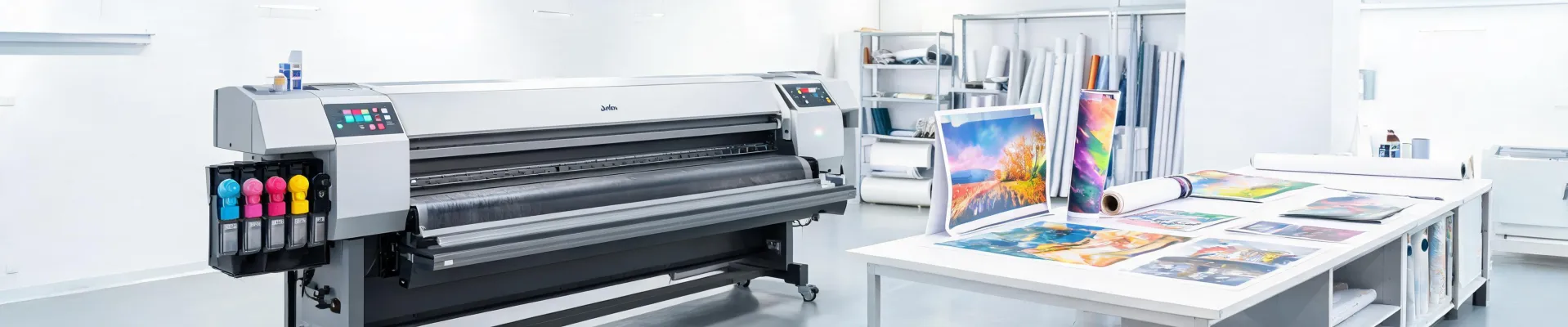
Why the Mutoh Eco Solvent Printer Is the Best Inkjet Printer for Photo Quality 2025
2026-08-19 · Elise Marceau
Let me start with a statement that might annoy the spec-sheet crowd: The best inkjet printer for photo quality in 2025 is not the one with the most impressive sample print. It is the one that keeps its word. I run a small commercial print operation, and I have personally made — and documented — seven significant equipment and workflow mistakes. They totaled roughly $28,000 in wasted budget. I do not say that to be dramatic. I say it because it is my qualification.
Why I do not trust sample prints anymore
I have been handling wide-format production orders for eight years. If I remember correctly, my first machine was a used solvent printer that a friend sold me at a 'deal' price. The word 'deal' should have been a warning. It made a gorgeous sample print. The problem appeared when we had to produce 200 identical pieces by Friday. By day two, the print heads were skipping. What I mean is, every third row had horizontal lines. Banding, in other words.
That mistake cost us about $890 in wasted ink and media, plus a week of client goodwill. It also taught me something nobody tells you: there is a difference between a printer and a production machine. A printer is something you can make nice things on. A production machine is something you can make a living on. They are not the same purchase.
Why the Mutoh eco solvent printer changed my math
I did not switch brands because I believed in the Mutoh logo overnight. It was a slow, practical realization. The Mutoh logo on the front of an eco-solvent machine is not magic. But it came from a company that has been making wide-format printers for a long time. I want to say since the 1950s, but do not quote me on that. The point is, the engineering is mature.
When I finally bought a Mutoh eco solvent printer, I was still waiting for it to fail. Put another way: I had been burned so badly that I expected every brand to have the same hidden issue. The machine ran through a 40-foot roll without a single head problem. That does not sound impressive, but for me it was the difference between babysitting a print and actually working on it.
Now, before someone accuses me of cherry-picking, fine: maybe I got lucky. I don't have hard data on industry-wide defect rates for every wide-format brand. But I can tell you anecdotally that our redo rate dropped after that change. I wish I had tracked the first year more carefully. I didn't, because I didn't think I would need to prove it to anyone. But the consumables bill had the same voice: fewer wasted runs.
What 'best inkjet printer for photo quality 2025' really means
Search results for the best inkjet printer for photo quality 2025 will give you a lot of lists. They compare droplet sizes, color gamut, speed, and price. Those specifications matter. They do not tell you what happens on day 300, after a few thousand feet of media have gone through the machine.
I used to run a Roland printer UV unit in a previous shop. It did good work, and Roland makes solid equipment. I am not here to tell anyone to throw away a working Roland. But when I started buying for my own shop, I looked at service responsiveness, replacement-part availability, and whether the local tech could get to me before my client started calling. The Roland printer UV was fine. The issue was not the brand. The issue was that I had never factored uncertainty into the cost.
People assume the lowest quote means the vendor is more efficient. What they don't see is which costs are being hidden or deferred. That is an old lesson from printing, and it applies to printers themselves. A $400 rush fee becomes easy to spend when the alternative is missing a $15,000 event. We paid exactly that in March 2024 for next-day material. It was not an extra cost. It was insurance.
What about the inkjet refill printer crowd?
I get emails from people who grew up on desktop inkjet refill printer systems, where the goal is to refill cartridges to save money. That logic does not translate to production solvent printing. Here is something vendors won't tell you: every time you refill a cartridge with unproven ink, you are betting your print quality on that specific batch. If the ink is not matched to the print head, the color shifts. In a production shop, a shift costs more than a cartridge.
One of the best decisions we made was moving to a bulk ink system on a machine designed for it. The Mutoh eco solvent printer gave us ink supply that I did not have to babysit. I don't know if that makes it the best inkjet printer for photo quality 2025 on paper. But in practice, it made our daily output more predictable.
Responding to the obvious criticism
You might be thinking, 'You are just rationalizing the extra cost.' Maybe. But consider this: I have only worked with mid-sized print shops, not with large-scale industrial operations. If you produce five prints a month for your own business, you can buy almost anything and be happy. The certainty premium only matters when your rent depends on deadlines.
I also know people will say the sample print from a new printer is the real proof. I used to think that too. Now I have a different approach. I ask what the machine can do after 200 runs, not what it can do on day one. The first service call tells you more than any polished demo.
I also avoid the word 'never' when talking about printers. Per FTC guidelines (ftc.gov), advertising claims should be truthful and substantiated. A claim like 'zero maintenance forever' is neither. Printers are machines; they need care. The best I can ask for is a maintenance plan that doesn't leave me stranded.
My final answer
So, for what it is worth, my answer to the search phrase 'best inkjet printer for photo quality 2025' is not a single spec sheet. It is the Mutoh eco solvent printer that has kept our deadlines intact. I am not saying it is the right machine for every shop. What I am saying is that reliability is a feature. And features cost money. The only mistake I regret more than buying cheap was trying to make a hobby-grade machine do industrial work. The premium for certainty is the cheapest insurance I know. It may not show up in a color gamut chart, but it shows up when your client needs it on Friday.

Elise Marceau
Elise Marceau is an LED display and digital-signage systems analyst covering LED video walls, modular screens, transparent LED, control processors, and indoor or outdoor signage. She applies IEC 62368-1 safety principles while comparing pixel pitch, luminance, contrast, refresh rate, colour uniformity, viewing angle, ingress protection, power density, module serviceability, and signal redundancy. Her specification guides help integrators, venue operators, retailers, and procurement teams align viewing distance, ambient light, content format, installation access, electrical load, and lifecycle support.