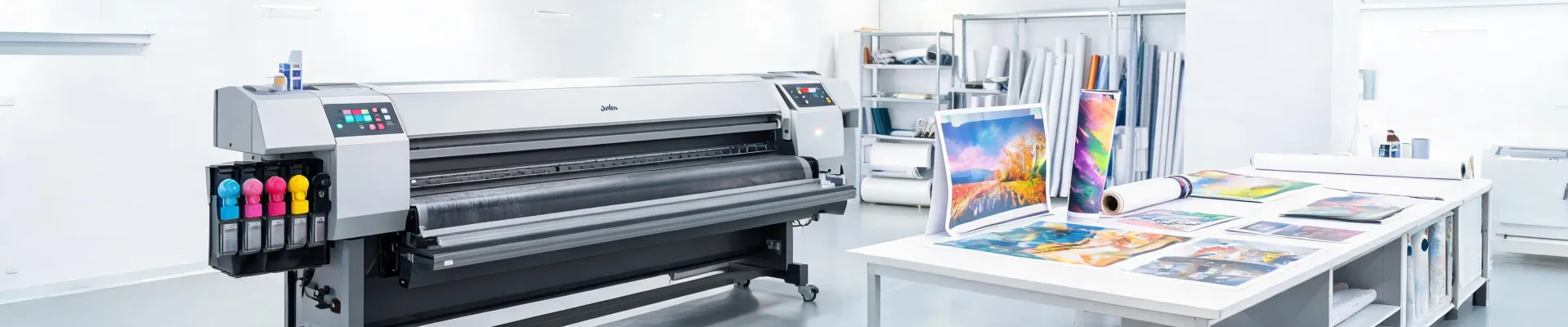
Mutoh Industrial Printers vs Desktop Alternatives: A Procurement Manager's Real TCO Comparison
2026-09-30 · Gabriel Moretti
Why I Built This Comparison (And What It Actually Covers)
I'm a procurement manager at a 45-person print services company. I've managed our equipment budget — about $120,000 annually — for the past 8 years. I've negotiated with 20+ vendors and tracked every order in our cost system.
Last quarter, our production manager asked me to evaluate whether we could replace one of our aging industrial printers with a cheaper desktop option. I'd seen the Canon Pixma TS705A inkjet printer reviews — they're solid for what they are. And budget DTF station printers keep showing up in my inbox with "promo" pricing. So I ran the numbers.
This isn't a product review. It's a TCO comparison across three categories that people keep asking me about: Mutoh industrial printers (UV flatbed, DTG, DTF), mid-range DTF station printers, and desktop inkjet alternatives like the Canon Pixma line.
Here's how I'm comparing them:
- Upfront cost vs. actual throughput — because a $400 printer that can't handle your volume is just an expensive paperweight
- Operating cost per unit — ink, maintenance, downtime
- Risk and hidden costs — the stuff that doesn't show up in a quote
One note before we start: I'm comparing these from a commercial print production context. If you're a solo designer printing samples at home, the calculus is totally different.
Dimension 1: Upfront Cost vs. Real Throughput
This is where the comparison gets interesting — and where I almost made a $4,000 mistake.
The Desktop Option (Canon Pixma TS705A and Similar)
The Canon Pixma TS705A runs about $80-120 depending on where you buy it. The reviews I read were genuinely positive — good color output for photos, decent print speed for home use, wireless connectivity that actually works.
But here's what those reviews don't tell you: this printer is rated for roughly 100-200 pages per month before you start running into issues. We produce 2,000-3,000 units weekly during peak season.
I calculated it out: we'd need 15-20 of these running simultaneously to match one industrial printer's output. And they'd need to run 12+ hours a day. At that point, you're not buying a printer — you're building a printer farm with 20 points of failure.
My gut said the math was absurd. But I ran it anyway. The numbers confirmed it: desktop inkjets aren't in the same category as production equipment. They're for proofing, small samples, or short-run specialty work.
The Mutoh Industrial Option
A Mutoh UV flatbed printer for sale in the mid-range config runs $45,000-$85,000 depending on bed size and configuration. A Mutoh DTG or DTF setup lands somewhere in the $15,000-$35,000 range.
That's a big number. I get it. But here's the thing — when I spread that $45,000 over a 5-year depreciation schedule and 250 production days per year, it's about $36 per day in equipment cost. Our old unit produced roughly $400-$600 in revenue per day. The math works because the throughput is there.
Where this gets counterintuitive: The "cheaper" DTF station printers I looked at ($3,000-$8,000 range) actually had a higher cost-per-print at our volume than the Mutoh DTF systems. Why? Because the cheap units max out at 20-30 shirts per hour with frequent ink clogs. The Mutoh runs 60-80 per hour with far less babysitting.
At our volume, the "expensive" option was actually the cheaper one per unit. That's the TCO trap most people fall into.
Dimension 2: Operating Cost Per Unit (Ink, Maintenance, Downtime)
I tracked our actual costs over 18 months across two Mutoh printers and one desktop unit we use for proofing. Here's what the data showed:
Ink Cost Per Square Foot / Per Unit
Our Mutoh UV flatbed runs about $1.20-$1.80 per square foot in ink cost for standard graphics. Sounds high until you compare it to desktop inkjet costs.
A Canon Pixma TS705A ink cartridge set (5 cartridges) costs around $60-80 and prints maybe 200-300 pages of mixed content. That's roughly $0.25-$0.40 per page. For a 13x19 print, you're looking at $1.50-$2.50 in ink alone — and you're doing it at 1/20th the speed.
For DTG and DTF: Mutoh's ink systems run $0.80-$1.50 per shirt in ink cost depending on coverage. The budget DTF station printers I tested used generic inks that were cheaper upfront but had a 15-20% higher waste rate due to clogs and inconsistent flow. Net cost was almost identical, but the downtime wasn't.
Maintenance and Downtime
This is where the real difference shows up.
Our Mutoh printers have scheduled maintenance cycles — daily, weekly, monthly. It's documented, predictable, and our techs know exactly what to do. Average unplanned downtime over 18 months: about 4 hours per month combined.
The desktop unit in our proofing area? We replace it every 14-18 months because something critical fails — usually the print head. That's $100-120 plus the time to reconfigure settings and profiles. Not a big deal for proofing. A disaster if it was a production machine.
And here's what nobody tells you about cheap DTF station printers: when they clog — and they will — clearing the line takes 45-90 minutes. At our production rate, that's $300-$600 in lost output per incident. If it happens twice a week, you've just paid for the more expensive machine in lost productivity.
I learned this the hard way in 2023 when we tried a budget DTF unit to "save money." It ended up costing us more in downtime than the price difference. We sold it after 6 months.
Dimension 3: Risk, Support, and the Stuff That Doesn't Show Up in Quotes
This is the dimension I used to ignore. I don't anymore.
Warranty and Support Infrastructure
Mutoh has a dedicated technical support network with parts distribution in North America. When a print head fails on a Tuesday morning, I can have a replacement by Wednesday. That's not marketing — that's from actual experience.
Canon's support for the Pixma line is consumer-grade. It's fine for what it is, but there's no "production emergency" channel. You ship it somewhere, wait 2-3 weeks, and hope.
With budget DTF station printers, support is often the manufacturer's WhatsApp number. I'm not exaggerating. I've been there. Response time varied from 20 minutes to 3 days.
Consumables Longevity and Parts Availability
Here's a real concern for anyone looking at a Mutoh printer for sale on the secondary market: parts availability. Mutoh supports their machines for 7-10 years after discontinuation. I confirmed this with our distributor in Q3 2024.
Desktop printers? They're disposable by design. Canon released the TS705A in 2019 and it's already getting harder to find OEM print heads. In 3-4 years, you'll be hunting for refurbished parts or buying a whole new unit.
Budget DTF printers are even worse — model cycles are 12-18 months. Good luck finding a replacement motherboard for a 2022 model in 2025.
The Hidden Cost of Color Consistency
This one cost us $2,800 last year.
We had a client with brand-critical colors — Pantone 286 C corporate blue, specifically. Industry standard tolerance is Delta E < 2 for brand colors, and trained observers can spot Delta E of 2-4.
Our Mutoh printers hold that tolerance consistently across runs when properly calibrated. The desktop unit we used for a small batch job drifted to Delta E of 5-6 after 50 prints. The client rejected the entire order. We reprinted on the Mutoh, ate the cost, and learned a lesson.
If you're doing anything brand-critical at scale, the calibration and consistency of industrial equipment isn't a luxury — it's the difference between a repeat client and a refund.
So Which One Should You Actually Buy?
After running TCO analyses on 8 different configurations across these three categories, here's my honest take:
Go with a desktop inkjet (like the Canon Pixma TS705A) if:
- You're producing fewer than 100 prints per week
- You're doing proofing, samples, or one-off specialty jobs
- You don't need color consistency guarantees
- Your failure mode is "I'll just buy another one"
These are genuinely useful machines for their niche. I keep one in our office. But they're not production equipment.
Go with a budget DTF station printer if:
- You're doing under 30-40 shirts per day
- You're willing to babysit the machine daily
- You have a backup plan for when it clogs mid-order
- You're in a learning/experimentation phase
Just don't pretend it's a production machine. It's an entry point.
Go with Mutoh industrial equipment (UV flatbed, DTG, DTF) if:
- You're producing 50+ units per day consistently
- Downtime costs you more than the machine payment
- You need documented color consistency
- You want a 5-7 year service life with parts availability
The upfront cost is real. But if you're running production volume, the per-unit economics and reduced risk make it the cheaper option over any meaningful time horizon.
I can only speak to our specific situation — a mid-size B2B shop with predictable order flow and brand-critical clients. If your business is seasonal, or you're just starting out, the calculus shifts. A lot.
But here's the frame I now use for every equipment decision: Don't compare prices. Compare cost per output unit at your actual volume, then add a risk premium for downtime. Every time I've done that math honestly, the "expensive" option was actually cheaper.
If you're currently evaluating a Mutoh printer for sale, or trying to decide between a DTG promo deal and a DTF station printer, run your own numbers with your own volume. The right answer depends entirely on where you sit on that curve — not on what the sticker price says.

Gabriel Moretti
Gabriel Moretti is a laser-processing equipment analyst specializing in fibre and CO2 laser cutting, marking, engraving, and welding machines for sheet metal, tubes, polymers, wood, and coated components. He applies ISO 11553-1 laser-safety requirements while comparing wavelength, rated power, beam quality, spot size, focal tolerance, cutting speed, kerf width, heat-affected zone, assist-gas demand, enclosure design, and extraction capacity. His engineering guides help fabricators and equipment buyers align source type, material response, process window, automation, guarding, and throughput expectations.