Inkjet vs Laser for B2B Print: Which Is Best (And Where Mutoh Fits)
2026-10-08 · Henrik Solberg
-
Dimension 1: Substrate Flexibility — Inkjet Wins by a Landslide
-
Dimension 2: Color Accuracy — Inkjet Wins for Brand Colors (If You Calibrate)
-
Dimension 3: Cost Per Print — Laser Wins for Volume Text; Inkjet Wins for Versatility
-
Dimension 4: Maintenance and Downtime — Laser Is Simpler, Inkjet Needs Discipline
-
Dimension 5: Use-Case Fit — The Only Dimension That Actually Decides
-
The Expertise Boundary: Why 'One Machine Does Everything' Should Scare You
My name is not important, but my job is. I'm a production manager handling wide-format print orders for 8 years. I've personally made (and documented) 12 significant mistakes, totaling roughly $23,000 in wasted budget. Now I maintain our team's checklist to prevent others from repeating my errors.
When I first started managing vendor relationships in 2017, I assumed laser printers were always the 'professional' choice for B2B. Laser was faster, sharper for text, and had lower cost per page—or so I thought. Eighteen months later, after a $3,200 banner order came back with melted edges from a laser trial (long story), I realized I was comparing the wrong things. For print service providers, the question isn't 'inkjet or laser' in general. It's 'inkjet or laser for this specific job.'
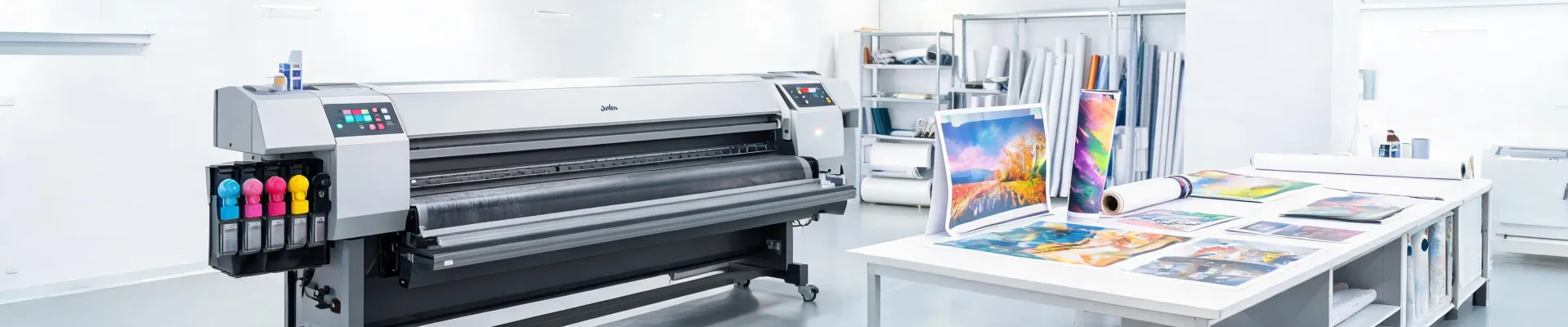
So here's the framework I use now. I compare five dimensions: substrate flexibility, color accuracy, cost per print, maintenance and downtime, and use-case fit. I'll put inkjet and laser head-to-head on each. Where it helps, I'll bring in specific machines we run: a Mutoh eco solvent printer for roll-to-roll, a Mutoh UV flatbed printer for rigid signs, and a Chinese DTF printer for garment decoration.
Dimension 1: Substrate Flexibility — Inkjet Wins by a Landslide
Laser printers are basically limited to paper, cardstock, and some specialty labels. That's fine if you're printing 10,000 black-and-white invoices. But if you're a sign shop printing on coroplast, acrylic, PVC, canvas, or garment transfers? Laser is out.
Inkjet—especially wide-format inkjet—handles a ton of substrates. A Mutoh eco solvent printer will run roll media like vinyl, banner, and heat transfer paper. A Mutoh UV flatbed printer prints directly onto rigid boards up to a few inches thick. And a Chinese DTF printer? That's inkjet too, shooting pigment ink onto PET film for t-shirts.
'Standard print resolution requirements: Commercial offset printing: 300 DPI at final size. Large format (posters viewed from distance): 150 DPI acceptable. These are industry-standard minimums.'
That matters because substrate flexibility is usually the deciding factor for B2B print providers. I've seen shops buy a laser because it was 'cheaper per page,' then turn down $15,000 in rigid signage work because they couldn't print on 5mm PVC. The inkjet printer benefits here are clear: you can say yes to jobs that laser shops have to turn down.
Dimension 2: Color Accuracy — Inkjet Wins for Brand Colors (If You Calibrate)
Laser toner can be surprisingly consistent, but it struggles with wide gamuts and Pantone matching. Inkjet, particularly with a good RIP and ICC profiles, gets closer to brand-critical colors.
'Industry standard color tolerance is Delta E < 2 for brand-critical colors. Delta E of 2-4 is noticeable to trained observers; above 4 is visible to most people. Reference: Pantone Color Matching System guidelines.'
Honestly, I used to think 'close enough' was fine. Then we printed 200 trade show banners with a logo that was supposed to be Pantone 286 C. The inkjet proof looked good on screen. The final banners were way more purple than blue. Delta E was probably around 6. Client rejected the whole run. That cost us $4,100 in redo plus a 1-week delay.
Now we require a hard-copy proof for any brand color. A Mutoh UV flatbed printer with a properly calibrated profile can hit Delta E under 2 on many substrates. A laser? I'm not 100% sure it can consistently hit that on anything but plain paper. Take that with a grain of salt—your RIP and toner quality matter a lot.
Dimension 3: Cost Per Print — Laser Wins for Volume Text; Inkjet Wins for Versatility
This is where I made my classic overconfidence mistake. In September 2022, I skipped testing a Chinese DTF printer's white ink circulation before a 200-piece order. I knew I should run a nozzle check and a test print, but thought 'what are the odds?' The odds caught up with me when 47 shirts had clogged nozzles and weak white ink. That error cost $890 in redo plus a 1-week delay.
But that doesn't mean inkjet is always more expensive. Let's compare:
- Laser: Very low cost per page for monochrome text. Great for high-volume office documents, invoices, and forms. But toner cartridges for color lasers are pricey, and you can't print on thick rigid substrates.
- Inkjet (eco-solvent): A Mutoh eco solvent printer has moderate ink costs, but it can print on cheap vinyl and banner material. For a 3x6 ft banner, cost per print might be $2-4 in ink. A laser can't do it at any cost.
- Inkjet (UV flatbed): Higher upfront machine cost, but you can print directly on expensive substrates and charge premium prices. Ink cost per square foot is fairly predictable once you profile.
- Inkjet (DTF): Chinese DTF printers have low entry cost, but you need to factor in film, powder, and maintenance. The upside was $2,000 savings on the printer. The risk was missing a 3-day deadline. I kept asking myself: is $2,000 worth potentially losing the client? For us, we chose a mid-range DTF with local support.
Dimension 4: Maintenance and Downtime — Laser Is Simpler, Inkjet Needs Discipline
Laser printers are pretty low-maintenance. Replace toner, replace drum, run a cleaning page. Inkjet—especially industrial wide-format—needs daily attention. Print heads can clog. White ink settles. Solvent inks need proper shutdown.
I'm somewhat skeptical of any vendor who says 'zero maintenance forever.' That's a red flag. A good supplier will tell you what you need to do: daily nozzle checks, weekly cleanings, proper humidity. The vendor who said 'this isn't our strength—here's who does it better' earned my trust for everything else.
With a Mutoh eco solvent printer, we run a morning nozzle check and a weekly cleaning. With the UV flatbed, we keep the print head capped and clean the UV lamp area. With the Chinese DTF printer, we had to learn its quirks—the powder shaker needed daily brushing. It's not hard, but it's not 'set and forget' either.
Dimension 5: Use-Case Fit — The Only Dimension That Actually Decides
Here's the comparison that matters. Don't ask 'which is best?' Ask 'best for what?'
- Choose laser if: You print high volumes of text documents, forms, invoices, or labels on paper. You need speed and low cost per page. You don't need wide format or rigid substrates.
- Choose inkjet if: You're a print service provider doing signage, banners, vehicle wraps, rigid signs, garment decoration, or packaging prototypes. You need substrate flexibility, color accuracy, and the ability to charge premium prices.
- Choose a Mutoh eco solvent printer if: You need reliable roll-to-roll output for outdoor signage and vehicle graphics. The ink is durable, and the machine is proven industrial-grade.
- Choose a Mutoh UV flatbed printer if: You print on rigid substrates like acrylic, foam board, wood, or metal. It's a specialist tool, and it does one thing very well.
- Choose a Chinese DTF printer if: You're entering garment decoration and need low upfront cost. But vet the spare parts supply and local support before you buy. I've seen too many shops save $3,000 on the printer and lose $5,000 in downtime.
The Expertise Boundary: Why 'One Machine Does Everything' Should Scare You
I've learned to be wary of any vendor promising a single machine that does laser-quality text, wide-format signage, and DTF transfers. That's not how physics works. The best shops I know have a small laser for office work and a dedicated inkjet for production. They know their boundaries.
Mutoh, for example, doesn't make laser printers. They focus on industrial inkjet—eco-solvent, UV, DTF, DTG, sublimation. That focus is why their eco solvent and UV flatbed printers have a reputation for reliability. If you need a laser, buy a laser. If you need industrial inkjet, that's a different conversation.
As of Q1 2025, the inkjet vs laser question for B2B print providers is mostly settled: inkjet wins for versatility and premium work. Laser still wins for high-volume text on paper. The mistake is trying to force one technology to do both.
So, inkjet printer or laser which is best? It depends on your job mix. If you're stuck between a Mutoh UV flatbed printer and a cheaper Chinese DTF printer, start with your job mix. Count how many orders need rigid substrates vs garment transfers vs roll signage. That count will tell you more than any spec sheet.
And if you take one thing from my $23,000 in mistakes: test the machine on your actual job before you buy. I'm not 100% sure it would have saved every disaster, but it would have saved most.

Henrik Solberg
Henrik Solberg is a commercial machinery safety, reliability, and procurement analyst covering display, audio, printing, sewing, cleaning, laser, welding, and supporting automation systems. He applies ISO 12100 risk-assessment principles and IEC 60300-3-3 lifecycle-costing guidance while comparing uptime, MTBF, MTTR, energy use, consumable demand, preventive-maintenance intervals, spare-parts lead time, training burden, installation constraints, and residual risk. His decision frameworks help plant managers, integrators, and procurement teams compare quotations, validate operating assumptions, plan acceptance tests, and select equipment on total delivered value.