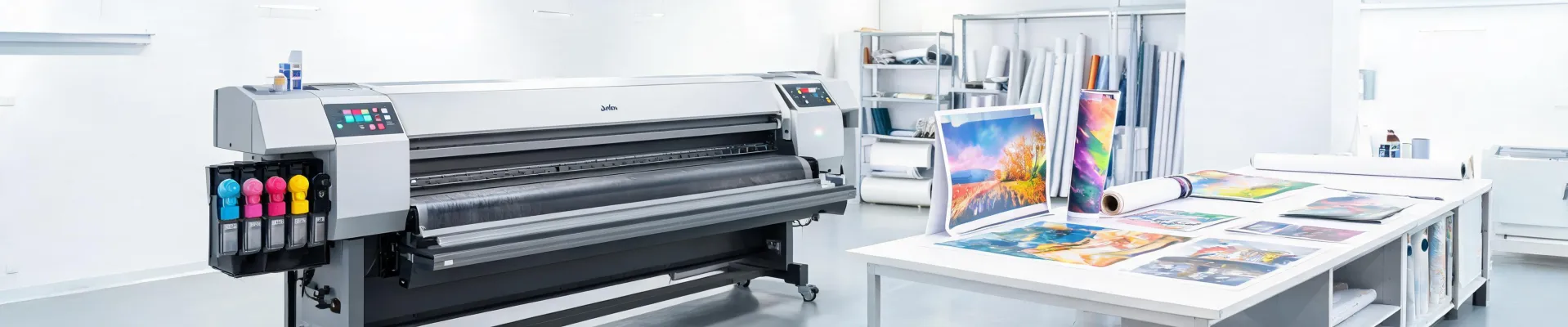
Printer workflow
I Almost Bought a Mutoh UV Printer on Price Alone. Here's What It Taught Me About Software, Service, and DTF Paper.
2026-08-19 · Elise Marceau
The Day the Quote Almost Worked
Our shop needed a UV flatbed for acrylic signs, short-run packaging, and some rigid board work. We got three quotes. One dealer quoted a Mutoh UV printer with what looked like a sharp price. I say 'sharp' because the sticker price was about $6,800 lower than the next bid. Maybe $7,100, I'd have to check the spreadsheet. The point is, it was enough to make me stop reading. But the lower quote didn't include a RIP license. It didn't include setup. It didn't include training. And it was light on the service side: standard remote support, parts on a waiting list, no guaranteed response time. Here's the thing: the dealer wasn't hiding it. I just didn't ask. I was comparing Mutoh UV printer price quotes like I was buying a car, looking at trim and mileage. That's the wrong frame. A wide-format printer is a production system, not a single box.The UV Printer Software Line Item
The UV printer software question is where the quote started to fall apart. A Mutoh UV printer doesn't just run a job from an office printer queue. It needs a RIP, or raster image processor, that translates files into a format the printer can handle, controls color management, and sets ink limits by substrate. On the lower quote, that software was 'not included.' Meaning thousands of dollars in additional cost plus weeks of waiting while we figured it out. On the higher quote, the software was there, loaded, tested, and set up with profiles for the media we actually use. What I mean is: the machine is only one piece. The rest is the workflow around it. If you're comparing UV printers, ask these questions before you ask the price:- Which RIP is included, and is it a full license or a limited version?
- Who builds and installs the color profiles for your substrates?
- Is training included, or are we paying extra for someone to show us the basics?
- What happens when a printhead needs replacement? Is it stock or special order?
The DTF Paper Question I Get All the Time
A few months later, a customer called and asked the question I now hear constantly: can you use DTF paper in a regular printer? I didn't laugh. Honestly, at the time, I wasn't entirely sure. So I researched it, tested it, and came up with a clear answer: No. That's not how it works. DTF paper, which is really a film, not paper, is coated to receive ink and then be transferred to fabric using a heat press. It requires a printer with white ink capability, a DTF ink set, and adhesive powder applied after printing. A regular inkjet printer doesn't have a white ink channel. The film can also be too smooth for regular rollers, it can curl, and the result won't have an adhesive layer that lasts through washing. Put another way: the phrase 'DTF paper' makes it sound like a consumable you can load into any printer. It's not. It's one part of a complete transfer system. Why does this matter for a Mutoh UV printer conversation? Because the same mistake repeats itself. People compare machines before comparing systems. It's tempting to think a printer is a printer. That oversimplification is exactly what costs production shops money.The 'Sublimation DTF Printer' Category That Isn't One
I also get searches for a 'sublimation DTF printer' as if it's one product category. It's not. Sublimation and DTF are two different workflows: Sublimation uses dye ink that turns into gas when heated and bonds with polyester fabric. DTF prints CMYK plus white onto PET film, then applies adhesive powder and heat-presses it onto the garment. Both use wide-format inkjet technology, but the ink, media, and finishing steps are different. Mutoh's lineup includes machines built for industrial use, but the configuration matters. A sublimation setup isn't automatically a DTF setup. If you're buying for a shop, don't assume one printer can switch back and forth without real changes. Ask what a given model is actually configured to do.When Paying for Certainty Became the Cheapest Option
Here's the part that changed my view on 'overpaying' for support. In March 2024, our RIP workstation died on a Thursday afternoon. We had a 3,000-piece order due the following Tuesday. The standard service queue was four days. Our vendor offered priority remote support for $475, which got us a technician on the same day and a working system by Friday night. That $475 felt like a lot until I did the math. The order was worth $14,000. The late penalty was $2,000. And the real cost would have been the customer relationship we'd lose over a missed deadline. I used to think rush fees were a waste. Now I understand that in an emergency, you're not paying for speed. You're paying for certainty. A 'probably on time' promise is riskier than an expensive sure thing.The cheapest quote is only cheap if nothing goes wrong. In production, something always goes wrong.
What I'd Do Differently
Look, I don't have hard data on what Mutoh UV printer prices look like in every region right now. My experience is based on about nine significant equipment purchases in an 11-year run, mostly in the sign and garment decoration space. If you're working in a very different setup, your experience may differ. But the broader lesson is stable. Here's the checklist I use now:- What's included beyond the Mutoh UV printer price? RIP, install, training, profiles.
- What is the service response time, in writing?
- Are parts stocked by the local distributor, or shipped from another country?
- Does the machine's configuration match the workflow we actually sell: UV, DTF, sublimation?
- What does downtime cost per day? Compare that against a higher-priced plan that covers it.

Elise Marceau
Elise Marceau is an LED display and digital-signage systems analyst covering LED video walls, modular screens, transparent LED, control processors, and indoor or outdoor signage. She applies IEC 62368-1 safety principles while comparing pixel pitch, luminance, contrast, refresh rate, colour uniformity, viewing angle, ingress protection, power density, module serviceability, and signal redundancy. Her specification guides help integrators, venue operators, retailers, and procurement teams align viewing distance, ambient light, content format, installation access, electrical load, and lifecycle support.