The 'Cheapest' Wide-Format Printer Quote Cost More: Choosing Mutoh for Stickers & Sublimation
2026-08-20 · Elise Marceau
-
If you're comparing wide-format printer quotes, start here
-
Why a printer purchase landed on an admin's desk
-
Printing stickers: the requirements nobody mentions
-
Sublimation printer examples: what I learned looking at real setups
-
The drafting-machine manual that changed my research
-
Comparing the finalists: Mutoh, KGK, and a third brand
-
When a wide-format printer is overkill
-
Boundaries of my advice
-
Three questions to ask any equipment vendor
-
The bottom line
If you're comparing wide-format printer quotes, start here
The lowest-priced quote for a wide-format inkjet printer is, in my experience, the one that costs the most. I say that after spending most of 2024 evaluating printers for a sticker and sublimation project at the manufacturing company where I run purchasing. Five vendors. Four different quote formats. One survived the process, and it wasn't the cheapest on paper.
It was a Mutoh. And the path to that decision started with a dusty drafting-machine manual from 1986.
I'm the office administrator, not a print technician. I've been managing procurement for a 40-person manufacturer since 2020—roughly $380,000 a year across 15 vendors. I don't know the chemical differences between sublimation inks, and I can't break down the mechanics of a piezoelectric printhead. But I do know when a vendor is hiding costs. That skill turned out to be the most useful qualification for this project.
Why a printer purchase landed on an admin's desk
Our marketing manager wanted to bring die-cut sticker production and sublimation printing in-house. The agency we used charged about $2,400 a month for stickers, labels, and promotional work. The math said an in-house printer would pay for itself within 18 months. Then everyone looked at me, because that's how equipment purchases work in a smaller company (note to self: get a job description review).
The trigger event that shaped my whole approach happened back in March 2023. A vendor quoted a "great deal" on shop supplies and couldn't produce a proper invoice. Finance rejected the expense. I ate $2,400 out of my department budget. Since then, my first question to any vendor is "What's NOT included in this price?"—not "What is the price?"
That question caused some interesting reactions from printer vendors.
Printing stickers: the requirements nobody mentions
Searching "inkjet printer printing stickers" surfaces a ton of hobbyist content and a few genuinely serious industrial options. The gap between those two worlds is way bigger than the price difference suggests.
For die-cut stickers, we needed:
- White ink capability—essential for printing on transparent vinyl or laying a white base under colors on dark materials
- Roll-to-roll media handling—adhesive vinyl in sheets is a workflow nightmare
- A take-up system to keep thin vinyl from curling and jamming
- Solvent or UV ink, because stickers live on bottles, car windows, and other unfriendly places
The white-ink requirement alone eliminated two contenders. One brand only offered white ink as an expensive "options package." Another said it wasn't available at all on the model we were considering. That's when I started noticing the difference between vendors who wanted to sell us a solution and vendors who wanted to sell us a price tag.
Sublimation printer examples: what I learned looking at real setups
Sublimation printing sounds more exotic than it is. The core idea: special dye transfers from printed paper onto polyester-based materials when heat and pressure are applied. That's how custom sportswear, mugs, and banners get their permanent, vibrant color.
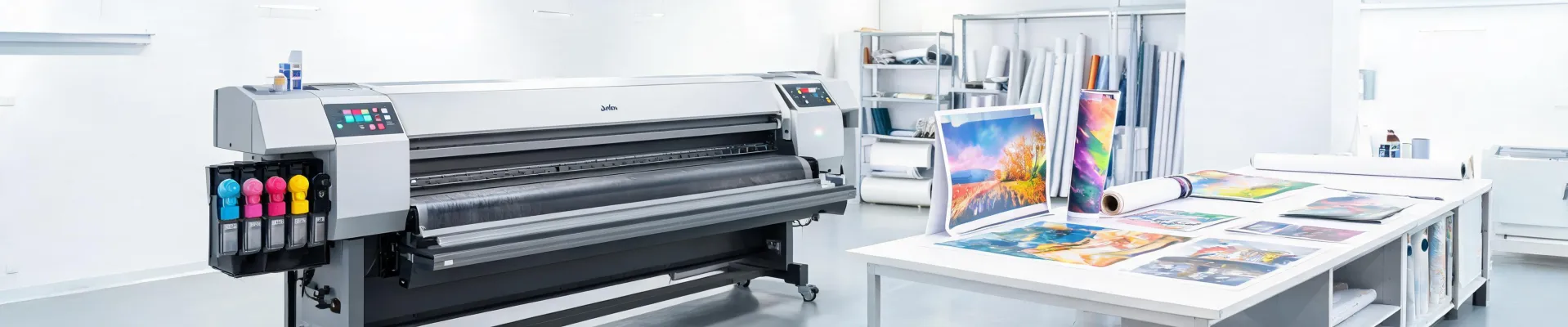
When I searched "sublimation printer examples," I found that most shops doing serious sublimation work use dedicated machines, because sublimation dye behaves differently from solvent ink. In our case, we wanted one printer that could handle both sticker work and sublimation transfers. That's a compromise. I'll be straight about that. We ended up with a Mutoh configured for solvent and sublimation work—it's not as efficient as a dedicated setup, but for a 40-person manufacturer producing small batches, it's the right trade-off.
I'm not 100% sure that's the right call for everyone. If you plan to do heavy sublimation volume, buy a dedicated sublimation printer and don't try to make one machine do everything.
The drafting-machine manual that changed my research
While I was searching for "mutoh" for the first time, our intern found a binder in the storage closet belonging to the old engineering department. It was a Mutoh drafting machine manual, copyright 1986, with handwritten margin notes and red-pen marks on the parts list.
Mutoh didn't start as a printer company. They built precision drafting machines—the mechanical drafting arms and rulers used to draw blueprints before CAD. Searching online, I noticed people still look for the "Mutoh drafting machine manual" today, hunting for parts and repair guides to keep 30+ year-old equipment running. That kind of product longevity says a lot about engineering culture. It made me less nervous about investing in their modern wide-format printers.
(I also like knowing I'm buying from a company that has outlived several technology cycles. That's a credibility signal no spec sheet can capture.)
Comparing the finalists: Mutoh, KGK, and a third brand
We narrowed from five vendors to three: Mutoh, KGK, and another established Japanese manufacturer. We asked each for itemized quotes in September 2024 and got very different answers.
The KGK inkjet printer information we reviewed looked solid in documents. Their specs were competitive and their base price came in about 12% lower. But when I asked about service coverage, the KGK distributor quoted "5 to 7 business days" for a technician visit. For a production machine, that was a deal-breaker. If a printer goes down on a Tuesday, I can't wait a week for someone to look at it.
The third brand (no need to name names—their equipment is fine) had a pricing structure that gave me flashbacks to my March 2023 disaster. The quote showed a very attractive base unit, then added line items for "software activation," "profile configuration," and "onsite commissioning." Technically accurate. But the final cost was 18% above what the first page suggested. That's the kind of thing my finance reports hate.
The Mutoh quote was the most transparent. It listed everything:
- Printer configured with white ink
- RIP software and profile package
- Delivery and installation
- Three-day on-site training
- Starter ink set
One line item each. No surprises. The invoice matched the quote. I shouldn't be this grateful for something that basic.
When a wide-format printer is overkill
One vendor told me, "every serious shop should buy wider than they need—it future-proofs your capabilities." That sounds progressive, but it's how companies end up with a $150,000 machine gathering dust because the anticipated work never showed up. We bought a 64-inch model, which is already more than we strictly need for 24-inch sticker rolls and 36-inch sublimation flags. The extra width buys flexibility. If I'm being completely honest, a 54-inch machine would have covered what we do today.
Buy for the demand you can see, not the demand you hope will appear. You can always trade up later.
Boundaries of my advice
I'm not a print specialist, so I can't speak to things like printhead durability or drop-on-demand physics. If you're in the market, talk to whatever production person will actually run the machine. Their input matters more than my procurement perspective on this.
Also, my "transparency beats low price" rule has limits. A transparent quote isn't automatically the best value—it just means the vendor is clear about what they're charging. Sometimes that clarity comes with a higher margin baked in. That's fine. The point isn't to get the cheapest deal; it's to know what you're comparing so you can make your own call.
And in fairness, the KGK rep was genuinely helpful during our evaluation. They just couldn't get past the service-coverage question. Good people, wrong setup for us.
Three questions to ask any equipment vendor
After 5 years of managing procurement, I've come to believe the machine is rarely the greatest risk—the vendor is. These three questions haven't let me down:
- What is included in this quote, line by line? A "total" without a breakdown means the breakdown exists and you should ask for it.
- What's NOT included that I might assume is included? The vendors who answer this honestly are rare. Protect them.
- If I call technical support next Tuesday, who picks up? This reveals more about the after-sales experience than any brochure.
Mutoh passed all three.
The bottom line
That 1986 Mutoh drafting machine manual is still in the binder, sitting on a shelf near my office. I glance at it sometimes. It's a reminder that precision engineering has a history—and that companies who build tools people keep for decades are worth paying attention to.
The Mutoh printer went into production in November 2024. It ran its first sticker job on a Tuesday morning, five days ahead of the marketing deadline. No surprise fees. No hidden costs. No finance rejections.
But one more thing I've learned since: no quote, however transparent, predicts everything. We've spent more time than expected calibrating color profiles for different vinyl brands. That's not a vendor failure or a machine flaw—it's just the nature of the technology. The difference is that when surprises came up, our Mutoh distributor worked through them without treating every phone call as a billable event. You can't put that in a spec sheet, but you'll feel it in the first year.
Take this with a grain of salt—my perspective is procurement, not print production. But if you're in the middle of your own printer search, remember: the number on the invoice at the end matters more than the number on the quote at the beginning. Choose a vendor who wants you to know both.

Elise Marceau
Elise Marceau is an LED display and digital-signage systems analyst covering LED video walls, modular screens, transparent LED, control processors, and indoor or outdoor signage. She applies IEC 62368-1 safety principles while comparing pixel pitch, luminance, contrast, refresh rate, colour uniformity, viewing angle, ingress protection, power density, module serviceability, and signal redundancy. Her specification guides help integrators, venue operators, retailers, and procurement teams align viewing distance, ambient light, content format, installation access, electrical load, and lifecycle support.