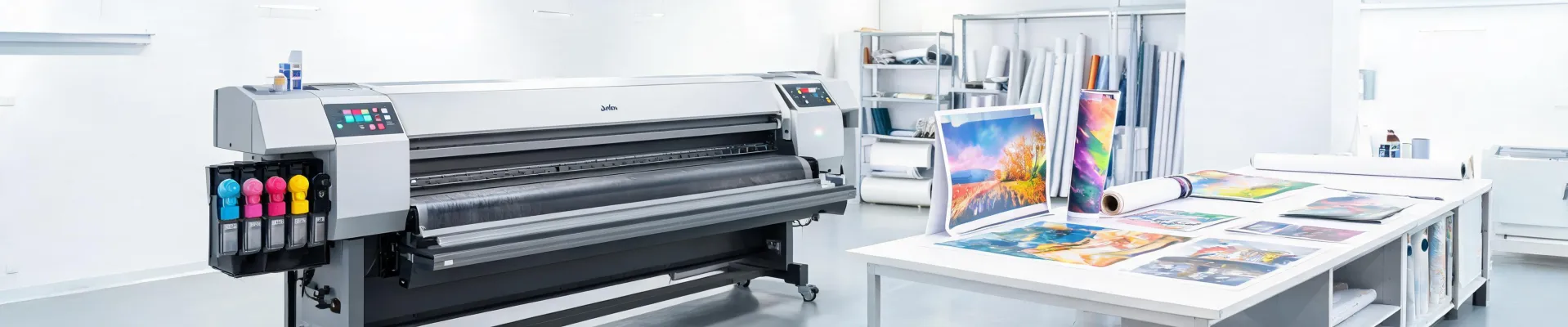
Mutoh ValueJet 628 vs. Hobby UV Printer: What I Learned About Price, Ink, and DTF
2026-08-20 · Elise Marceau
-
Why Compare a Mutoh ValueJet 628 and a Hobby UV Printer?
-
Dimension 1: Mutoh ValueJet 628 Price vs. Hobby UV Price
-
Dimension 2: Repeatable Print Quality
-
Dimension 3: Mutoh Ink Suppliers and the Hidden Cost of Ink
-
Dimension 4: Service, Support, and Downtime
-
What About DTF and the xTool DTF All-in-One Apparel Printer?
-
When a Hobby UV or xTool DTF Makes More Sense
-
Final Thoughts
I've handled production printing orders for about eight years. In my first year (2017), I made the classic mistake: I bought a cheap desktop UV printer because I assumed a printer was a printer. It wasn't. That single decision cost me roughly $6,800 in failed prints, wasted table time, and one very irritated client before I swapped it for something that could actually run a job.
Now I maintain a checklist that's caught 47 potential errors in the past 18 months alone. The first item on that checklist? Match the machine to the work. This article is a comparison between the Mutoh ValueJet 628—a real production machine—and the hobby-level UV printers that show up in every 'cheap flatbed' search. I'm also going to touch on DTF because the landscape has changed, and what was best practice in 2020 may not apply in 2025.
Why Compare a Mutoh ValueJet 628 and a Hobby UV Printer?
If you're searching 'Mutoh ValueJet 628 price' and then looking at a $3,000 hobby UV printer, I get it. The price gap is massive. But these two machines are not variations of the same thing; they're different tools for different businesses. The comparison framework should be: upfront cost, cost per usable print, repeatable quality, ink ecosystem, and service availability.
I'm not going to tell you that Mutoh is for everyone. I'm going to tell you what I should have been told before I wasted budget on the wrong equipment.
Dimension 1: Mutoh ValueJet 628 Price vs. Hobby UV Price
When I first started buying equipment, I assumed the lowest quote was the best starting point. I was wrong. A new Mutoh ValueJet 628 typically lands between $22,000 and $28,000 with installation, training, and initial support from an authorized dealer (based on publicly listed distributor quotes, March 2025; verify current pricing). A hobby UV printer from an online marketplace can be as low as $1,500 to $6,000 (based on publicly listed prices, March 2025; verify current pricing).
That difference is brutal. I don't want to dismiss it. But here's the thing: the machine price is the least important number on the quote. The real number is cost per usable print.
The $3,000 machine I bought produced beautiful sample prints. On a real order with 100 identical pieces, though, it failed often enough that I'd lose two or three out of every batch. It needed re-leveling, the UV lamp overheated, and the software dropped coordinates. That's not a price; that's a tax.
Look, I'm not saying budget machines are always bad. I'm saying they're riskier. The ValueJet 628 is designed to run continuous production. The hobby UV is designed to make gifts and samples. Period.
Dimension 2: Repeatable Print Quality
When I compared my first hobby UV with a Mutoh ValueJet 628 side by side, I finally understood why industrial equipment costs more. It's not about resolution—most of these machines claim similar DPI. It's about consistency.
The Mutoh holds registration across a full 64-inch roll. The hobby UV can be okay for a single 13x18 piece, but it drifts when you push a longer run. On one $3,200 order, every single print had a subtle color shift because the hobby UV's ink temperatures varied in the middle of the run. $3,200. Straight to the trash. That's when I learned the difference between a printer and a production printer.
To be fair, a hobby UV printer is not completely useless. It can do short runs, small gifts, and product decoration. But if a client is paying you for 500 identical pieces, you do not want to learn about repeatability on their job.
Dimension 3: Mutoh Ink Suppliers and the Hidden Cost of Ink
Here's something vendors won't tell you: the first quote on ink is almost never the final price. Shipping, hazmat fees, and minimum orders add up. And if you buy a cheap printer that uses proprietary cartridges, you're locked into whatever that manufacturer charges.
Mutoh ink suppliers are not all the same. Authorized distributors sell OEM fluid that's formulated for the printhead. For the ValueJet 628, OEM ink roughly runs $110 to $160 per liter depending on color and supplier (based on authorized reseller listings, March 2025; verify current pricing). That's not cheap. But third-party ink is a gamble I no longer take after seeing a clogged industrial printhead cost more than a year of ink savings.
With a hobby UV printer, the ink set is often proprietary cartridges in the $80 to $150 range per set. But here's the catch: those cartridges don't last long, and the cost per square foot is often higher than a production printer using bulk ink. That's the trap. The machine is cheap. The ink is not.
In the last 18 months, I've added an ink cost per square foot check to our pre-flight list. It's caught 47 potential errors. The biggest one? Assuming a cheap machine means cheap output. It doesn't.
Dimension 4: Service, Support, and Downtime
The ValueJet 628 has something that no hobby UV printer I've seen can match: a real service network. When something breaks, I can get spare parts and a technician who's seen the machine before. With my old hobby UV, a circuit board failed and I had to send it overseas for repair. That was three weeks of downtime during a production month. Never again.
Dedicated technical support and spare parts service are not optional if you're running a business. They're part of the cost. If you're comparing 'Mutoh ValueJet 628 price' to a $2,000 alternative, add the cost of one service call and three weeks of lost production to the $2,000. Then compare.
What About DTF and the xTool DTF All-in-One Apparel Printer?
The printing industry changed again when DTF became reliable. What was best practice in 2020 may not apply in 2025. For apparel, a DTF printer is often a better first investment than a UV machine. The workflow is completely different, and the equipment is purpose-built for garment decoration.
I've read a lot of xTool DTF all-in-one apparel printer reviews while helping customers choose between garment and general printing. The xTool unit gets credit for being easy to set up and friendly for small shops. But all-in-one reviews also mention limited production speed and small batch capacity. That matters if you're planning to scale.
Something else comes up in search data: the phrase 'Arizona DTF printer.' This is a common point of confusion. The Canon Arizona series is a large-format UV flatbed printer, not a DTF machine. If you're looking for garment DTF, you're looking at a different product category entirely. That confusion is exactly why you need to compare the tool to the work, not the keyword to the trend.
When a Hobby UV or xTool DTF Makes More Sense
I'm not going to end this with 'just buy the Mutoh.' That would be lazy. Here's how I'd decide now:
- Choose the Mutoh ValueJet 628 if you're taking on production signage, banners, vehicle graphics, or any work where a missed deadline burns a client relationship.
- Choose a hobby UV printer if you're making prototype products, samples, or small gifts and you can absorb failures without losing a contract.
- Choose an xTool DTF all-in-one apparel printer if you're printing custom shirts and small garment orders, and your volume does not yet justify a full production DTF line.
There is no universal best machine. There is only the machine that matches your volume, your support needs, and your tolerance for risk.
Final Thoughts
I still remember the frustration of watching a cheap printer turn a $3,200 order into trash. That mistake taught me a simple lesson: the price tag is not the price. The price includes training, ink, maintenance, downtime, and the value of your reputation.
If you're weighing a Mutoh ValueJet 628 against a hobby UV printer, ask yourself one question: are you buying a printer, or are you buying capacity to deliver? Because I've made the wrong choice. And it does not save you money. It costs you credibility. Done.

Elise Marceau
Elise Marceau is an LED display and digital-signage systems analyst covering LED video walls, modular screens, transparent LED, control processors, and indoor or outdoor signage. She applies IEC 62368-1 safety principles while comparing pixel pitch, luminance, contrast, refresh rate, colour uniformity, viewing angle, ingress protection, power density, module serviceability, and signal redundancy. Her specification guides help integrators, venue operators, retailers, and procurement teams align viewing distance, ambient light, content format, installation access, electrical load, and lifecycle support.