Mutoh Large Format Printer: 9 Years of Mistakes and What I'd Buy Now
2026-08-18 · Elise Marceau
-
How I learned this the expensive way
-
Mutoh large format printer: what to look for
-
The small-shop mistake that still bothers me
-
What about the HP Deskjet question?
-
Color, resolution, and the numbers I check now
-
Workflow extras that are not optional
-
MyColor DTF and K13 DTF: practical notes
-
When a Mutoh isn't the right answer
If you're shopping for a Mutoh large format printer, stop comparing spec sheets and start comparing service ecosystems. After nine years in production printing, I've documented roughly $31,000 of my own preventable mistakes. The conclusion I keep coming back to: the best Mutoh isn't the one with the most printheads. It's the model your local tech can keep running, your staff can handle, and your order mix actually justifies.
How I learned this the expensive way
I started in 2017 with the classic beginner's mistake: I assumed the biggest, fastest machine was the safest bet. Our shop needed a Mutoh uv flatbed printer for rigid signs, so I pushed for a model with the largest bed and maximum options. Three weeks later, I approved a $3,200 order printed with the wrong color profile. The white ink underneath was fine. The CMYK overprint was not. Every single panel was off by a noticeable shift in the client's brand blue. I checked the file myself, approved the proof, and still missed it.
That's when I learned the real spec that matters is the one nobody prints on a brochure: spare parts availability and support response. (Note to self: always ask for damper lead times before signing.) A UV flatbed sitting idle for a week because of a $40 part is a lot more expensive than the part itself.
Mutoh large format printer: what to look for
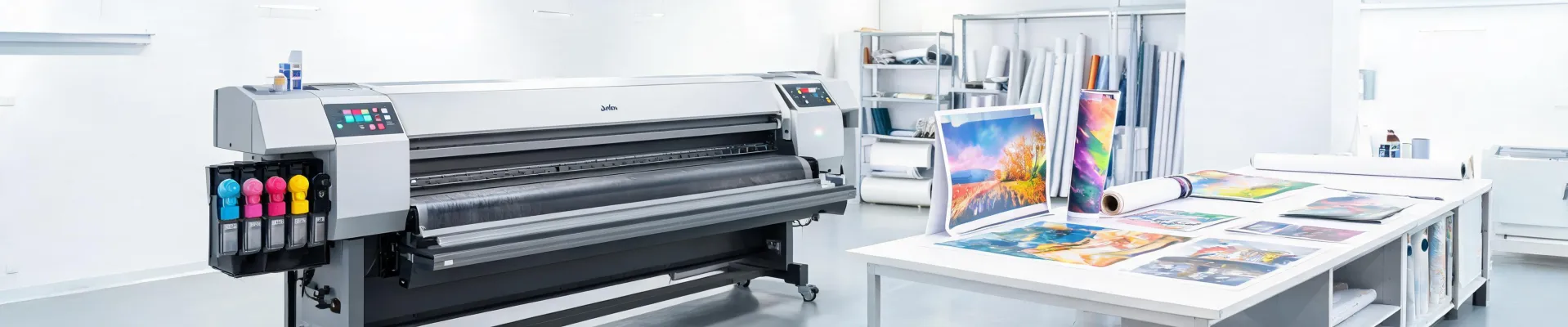
I've spent most of my time on Mutoh ValueJet eco-solvent machines, and I've watched techs service the XpertJet and UV lines. The Mutoh large format printer family has a few broad categories, and they aren't interchangeable:
- Eco-solvent models are versatile for vinyl and flexible media.
- UV flatbeds handle rigid panels, acrylic, and board with less media handling.
- DTF transfer machines, including the MyColor DTF printer and K13 DTF printer, are for garment decoration with transfer film.
If you're thinking about a MyColor DTF printer, understand that it's part of a workflow. The printer, the powder shaker, the curing oven, and the film all have to work together. I've seen small shops buy a K13 DTF printer and then struggle because they'd budgeted zero time for learning the transfer process. It isn't hard, but it is not a one-button operation.
The small-shop mistake that still bothers me
I also need to say something about being a smaller customer. When I was starting out, vendors would sometimes ignore my questions because I wasn't ordering truckloads. The ones who treated my $200 orders seriously are the ones I still use for $20,000 orders today. Small doesn't mean unimportant—it means potential. Don't let a salesperson guilt you into buying more machine than you need. A Mutoh UV flatbed printer is a serious investment, but you can start with a used or entry-level model and still deliver professional results.
What about the HP Deskjet question?
People often land on pages like this after typing 'is the hp deskjet a inkjet printer?' into a search bar. For the record: yes, it is. The HP Deskjet is a consumer inkjet printer. But if you're evaluating a Mutoh large format printer, you're in a different category entirely. The print tech shares the same basic idea—droplets of ink applied to media—but the width, durability, printhead design, and cost model are nothing alike. Comparing a Deskjet to a Mutoh UV flatbed is like comparing a bicycle pump to an air compressor. Both move air; they just serve completely different jobs.
Color, resolution, and the numbers I check now
Now that I maintain our team's pre-flight checklist, I run every new substrate through the same tests. First, color: according to Pantone guidelines, brand-critical colors should land at Delta E below 2. Anything from 2 to 4 is noticeable to a trained eye, and above 4 is visible to most clients. I've watched so-called fine prints fail because someone didn't calibrate for a textured vinyl. (Surprise, surprise.)
Second, resolution. For large format work viewed from a distance, 150 DPI is often fine. For commercial print that will be examined up close, 300 DPI is the standard. The math is simple: print size in inches equals pixel dimensions divided by DPI. A 3000 x 2000 image at 300 DPI gives you a 10 x 6.67 inch print. At 150 DPI, it's 20 x 13.33 inches. This seems obvious in writing, but I've eaten the cost of a blurry banner because I trusted a client's logo that came from a website.
Workflow extras that are not optional
A Mutoh UV flatbed printer won't perform well in a dusty, unpainted garage with a basic power strip. I know because one of my early orders failed due to voltage drops. Another time, the printer head crashed into a warped panel because the vacuum table wasn't holding it flat. That was an $890 redo plus a one-week delay, and it was not the printer's fault.
You also need color management. Mutoh machines are solid, but the weakest link is almost always the chain from monitor to profile to substrate. If you skip building a custom ICC profile for the media, you're guessing. Guesswork is expensive. In the past 18 months, our checklist has caught 47 potential errors before they reached the printer. That doesn't mean I'm perfect—it means the process is.
MyColor DTF and K13 DTF: practical notes
If you're specifically comparing MyColor DTF printer options, here's my practical advice: buy from a seller who can give you a same-week answer on consumables and spare parts. The K13 DTF printer can be a strong fit for garment decorators who want to produce transfers on demand. But DTF depends on consistent temperature and humidity. We keep a simple hygrometer near the printer, and our transfer failure rate dropped noticeably once we understood how much the environment matters.
When a Mutoh isn't the right answer
All of this said, Mutoh isn't automatically the right choice for everyone. If your total output is less than a few hundred square feet per month, outsourcing might make more financial sense than owning any large format printer. If you only need 11-inch-wide prints, a wide-format machine is overkill. And if you're not ready to maintain humidity levels and invest in color management, the printer will still work—but your results will be inconsistent.
This advice is based on my experience through Q1 2025. Print technology, consumable pricing, and service networks change quickly. Verify current support coverage, ink costs, and parts availability with your local Mutoh dealer before making a decision.

Elise Marceau
Elise Marceau is an LED display and digital-signage systems analyst covering LED video walls, modular screens, transparent LED, control processors, and indoor or outdoor signage. She applies IEC 62368-1 safety principles while comparing pixel pitch, luminance, contrast, refresh rate, colour uniformity, viewing angle, ingress protection, power density, module serviceability, and signal redundancy. Her specification guides help integrators, venue operators, retailers, and procurement teams align viewing distance, ambient light, content format, installation access, electrical load, and lifecycle support.