Which Mutoh Printer Should You Choose? A Scenario-Based Guide for Last-Minute Jobs
2026-08-12 · Elise Marceau
I've been a production coordinator at a print company for ten years, and in that time I've handled more than 200 rush orders. Some as small as a $500 proof-of-concept, one as large as a $15,000 trade show campaign that came in on a Tuesday and had to ship by Friday. The question I get from people comparing machines is always the same: "Which Mutoh should I buy?"
My honest answer is: it depends entirely on which part of your life is on fire when you ask me. So let me walk you through the four scenarios that actually show up in our shop—and the Mutoh printer that gets us out alive in each one.
Before we go further, one note for a specific reader: if you're searching for a Mutoh drafting machine manual, you might be restoring a vintage plotter. I get it—my first job in this industry was with one, and I still keep a manual on my shelf as a reminder that Mutoh has been about precision since decades before inkjet existed. That old manual won't tell you anything about CMYK, but it tells you everything about the brand's obsession with accuracy. Now, back to the present-day emergency.
How to classify your emergency
I start with three questions:
- What substrate are you printing on? Rigid plastic/foam board, or flexible vinyl/fabric?
- What's the absolute minimum turnaround? Do you have 48 hours, or a week?
- What matters more today: a brand-critical color match, or cost per square foot for the next year?
Your answers put you into one of four lanes. Here's what each lane recommends.
Scenario A: Color-critical rigid graphics in 48 hours
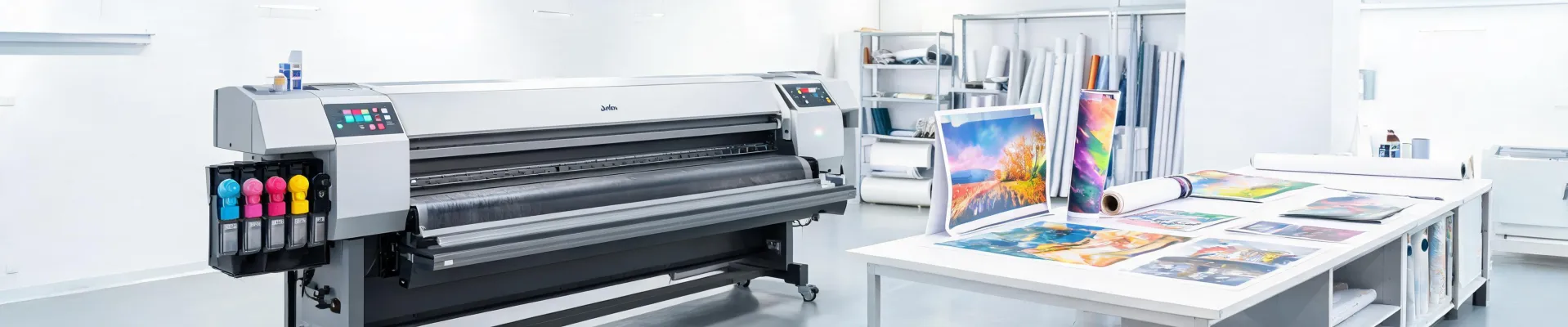
If you're producing acrylic signs, corrugated displays, or foam board for an event, the Mutoh XpertJet 461UF flatbed UV-LED printer is the tool I'd choose. Flatbed UV prints directly onto rigid panels, so you skip lamination, skip off-gassing, and skip the extra day a roll-to-roll setup usually demands.
In March 2024, a client called at 2pm on a Tuesday. Their competition had canceled, so they unexpectedly took over a trade show booth and needed 24 acrylic shelf talkers by 8am the next day. Normal lead time for a job like that at our shop is five days. We loaded the panels onto the XpertJet 461UF, pulled the profile for their acrylic, and ran the whole lot by 7pm. The color check took the longest—about 15 minutes. The final red matched the client's Pantone reference within a Delta E of 1.8. That's not a number I calculate for every job, but we do measure brand-critical colors. For context, a Delta E under 2 is the cutoff most brand guides use. Above 4, even a layperson can see the mismatch. And for a piece that people will examine up close, you'll want the full 300 DPI at final size—not the 150 DPI shortcut that's acceptable for large-format posters viewed from across a room.
That whole order was $1,100. Not a massive industrial order, but it meant a client who now sends us recurring work. Don't let anyone tell you a $500 order is too small to matter. In my experience, the people who treat small orders with respect are the ones we later trust with $20,000 jobs.
Scenario B: 100+ custom shirts by Friday
If the deadline is attached to a class reunion, a festival, or a company event, and the deliverable is textile transfers, you want a Rainbow DTF printer—or something in that family. DTF, or direct-to-film, prints a full-color image onto a transfer film, then you heat-press it onto a shirt. The beauty is that there's no screen setup. You can print one shirt or 500 with the same setup time: zero.
I didn't fully understand this until a job in 2023 when my usual screen printing vendor quoted ten business days. The client had four. We pulled out our DTF transfer setup—a Rainbow DTF printer with CMYK plus white—and had a proof in the client's hands in 90 minutes. We heat-pressed the first test on an 80 lb cotton tee to check the hand feel, adjusted the platen temperature by 10 degrees, then ran the rest. The whole order of 150 shirts took five hours. Screen printing would have been cheaper at 500 units, but for this batch, DTF was the only way to hit the deadline. The prints survived the wash test that afternoon.
Looking back, I should have asked for the exact shirt color before quoting. I assumed white shirts, but they arrived gray. The white ink layer under the DTF transfer handled the color difference fine—just not as fast as it would have on white fabric. (Ugh. Overnight shipping saved us, but barely.)
Scenario C: High volume, high ink costs eating your margins
Now the quieter emergency: it's not a deadline, it's a budget. If you're printing banners, vehicle wraps, or fleet graphics every week, the sensible choice is a wide-format eco-solvent or resin printer with a true inkjet refillable printer architecture—bulk ink tanks instead of cartridges.
This isn't a sexy selling point, but it's why I'll never apologize for being a nerd about cost per square foot. At the start of 2024, we did a side-by-side comparison of a cartridge-based system and a refillable ink system on two identical jobs—100 banners, same design, same media. The refillable system used 38% less ink per banner, and the ink cost per square foot dropped from around $0.17 to $0.06 after the first month. I might be misremembering the exact pennies per square foot, but the gap stuck with me. That's why every Mutoh ValueJet we've bought since then came with the bulk ink option.
I'm not a color scientist, so I won't pretend the switch was friction-free. The first time we moved from cartridges to bulk ink, we had to re-profile the whole printer. We spent a full day on it. But after that, it was smooth—and we cut our empty cartridge waste by roughly three-quarters. (Surprise, surprise: fewer plastic boxtops to dispose of also makes the shop cleaner.)
Scenario D: "Small character inkjet" is a different animal
I see the search term wholesale small character inkjet printer in our site analytics, and I want to save you the same mistake I almost made in 2022. I was helping a friend who owns a beverage company research small-character inkjet printers because the printhead coding lot numbers on their bottles kept jamming. A wide-format printer is not the answer. Mutoh doesn't make those either. You need a CIJ or a thermal-inkjet coder—a completely different class of equipment built to print on curved plastic or glass at production-line speed.
If that's actually your need, stop reading here and talk to packaging line engineers. Don't ask a wide-format printer salesperson; ask a coding equipment specialist.
But if you landed on that term because you're comparing production inkjet options for short-run packaging labels or boxes, then the earlier scenarios still apply. Rigid box blanks? Scenario A. Flexible packaging film? That's a different Mutoh model—one I don't touch in my daily work, and you should talk to a technical rep about it.
So, which scenario are you in?
Here's the decision shortcut I use after about a hundred phone calls:
- Rigid substrate and a specific event deadline? Go with the Mutoh flatbed UV—ideally the XpertJet 461UF.
- Fabric and quantity under 500? Go DTF, and a Rainbow DTF printer is a proven option.
- Regular volume over 1,000 square feet per day? Go with a refillable eco-solvent model to keep your cost per square foot sane.
If you're still not sure, pick up the actual material you need to print and the brand color palette. That's the physical reality. With those two items, I can tell you in ten minutes—but you can't tell yourself in ten minutes of staring at a spec sheet.
As of January 2025, Mutoh's lineup has grown dense enough that the old "which one is best" question is almost meaningless. The useful question is: "Which one fails me least when everything is on fire?" That's the one I've tried to answer here.
If you're still uncertain, call us. But don't call without knowing your substrate and your deadline. That's the only way we can rescue you.

Elise Marceau
Elise Marceau is an LED display and digital-signage systems analyst covering LED video walls, modular screens, transparent LED, control processors, and indoor or outdoor signage. She applies IEC 62368-1 safety principles while comparing pixel pitch, luminance, contrast, refresh rate, colour uniformity, viewing angle, ingress protection, power density, module serviceability, and signal redundancy. Her specification guides help integrators, venue operators, retailers, and procurement teams align viewing distance, ambient light, content format, installation access, electrical load, and lifecycle support.