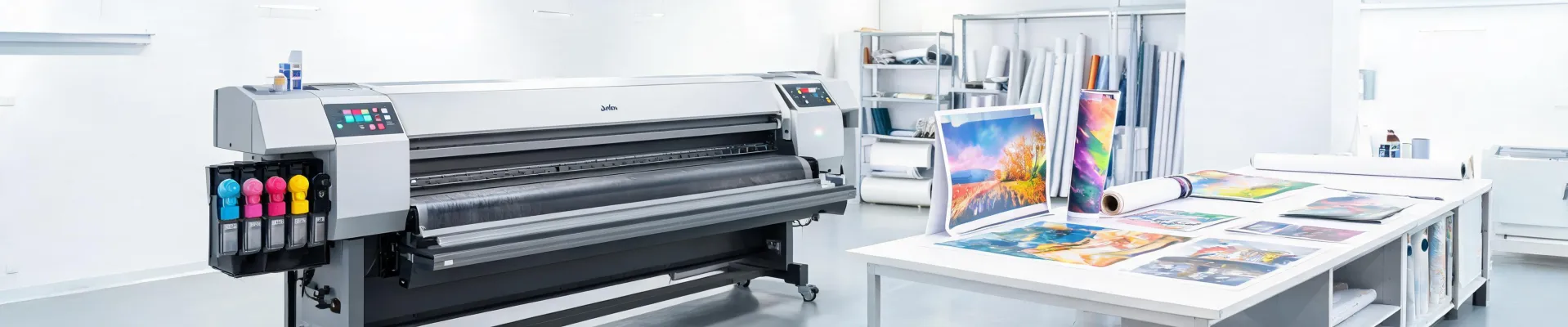
Mutoh Flatbed Printer, Mutoh Large Format Printer, and the Free DTF Printer Trap: A Cost Controller's Guide
2026-08-13 · Elise Marceau
-
Before You Pick a Scenario
-
Scenario 1: You Produce Rigid Panels Weekly -> a Mutoh Flatbed Printer Deserves a Quote
-
Scenario 2: Roll-to-Roll Graphics Are Your Mainstay -> a Mutoh Large Format Printer Pays for Itself
-
Scenario 3: Labels and Small-Format Work -> Think Twice Before Buying a Big Machine
-
Scenario 4: The 'Free DTF Printer' Offer -> Read the Contract Before Anything Else
-
Which Scenario Are You In? Try These Five Questions
When I first started managing print procurement, I assumed the best way to save money was to buy the machine with the lowest invoice price. Six years and roughly $180,000 in tracked print spending later, I'd say the opposite is closer to the truth.
I'm the procurement manager at a 16-person sign and display company. I've compared quotes from more than 30 vendors, built a cost-tracking spreadsheet that covers every printer, ink order, and service call, and made my share of mistakes. The big lesson: there is no universal best printer. There is only the best fit for your volume, your substrate, and your cost model.
This is not a review. It's a decision framework. I'd rather spend ten minutes explaining the scenarios than watch someone buy a $60,000 machine they use ten hours a week. An informed customer asks better questions and makes faster decisions.
Before You Pick a Scenario
Before reading the scenarios, ask three questions. What are you actually printing every week? Rigid panels, roll-to-roll graphics, labels, or garment transfers? Who is going to operate and maintain the machine? What happens if the machine is down for two days?
If you can't answer these, the scenario below won't help. Because the machine is never the whole cost.
Scenario 1: You Produce Rigid Panels Weekly -> a Mutoh Flatbed Printer Deserves a Quote
If your shop regularly prints on acrylic, PVC foam board, Dibond, or corrugated plastic, you're a flatbed candidate. A Mutoh flatbed printer can handle rigid substrates directly, which removes the mounting step you deal with when printing on vinyl and then laminating to board.
When I audited our 2023 spending, we had sent $38,000 to trade printers for rigid panels. I built a TCO model that included ink, substrate, labor, spoilage, and a realistic maintenance allowance. Our equivalent in-house cost came out around $45 per panel versus the $120 to $180 per panel we were quoted by trade printers in early 2025. The gap was large enough that a flatbed got serious quickly.
One important detail is color tolerance. If you're printing brand-critical signage, the industry standard is Delta E < 2 for brand colors. A production flatbed with good color management can get you there. You also need a consistent file workflow, because the machine doesn't fix bad artwork.
Here's the part that surprises people: the purchase price isn't the main risk. Utilization is. A flatbed that runs 10 hours a week is an expensive shelf. Before you commit, estimate your weekly flatbed hours. If they're under 15, outsourcing may still be cheaper when you include labor and downtime.
Scenario 2: Roll-to-Roll Graphics Are Your Mainstay -> a Mutoh Large Format Printer Pays for Itself
Banners, vehicle wraps, window graphics, posters, and floor graphics are roll-media jobs. A Mutoh large format printer is the workhorse here. It prints in rolls, often with eco-solvent or UV-cured inks depending on the model, and lets you move from file to finish without an external print provider.
Resolution matters, but not in the way most buyers think. Commercial print baseline is 300 DPI at final size. For banners and posters viewed from a distance, 150 DPI is generally acceptable. The file, the media, and the operator matter more than the extra digit on a spec sheet.
If your mix is mostly roll media, don't let a flatbed demo distract you. Build your operation around the substrate you see in your order log. A large format printer plus a laminator is often the stronger investment.
Scenario 3: Labels and Small-Format Work -> Think Twice Before Buying a Big Machine
Let's talk about labels, because this is where overbuying happens. Search for 'printer labels inkjet' and you'll see desktop printers, label sheets, and ink costs. The Canon Pixma TR8620A all-in-one inkjet printer is a perfectly good office device for occasional labels, shipping labels, and a few sheets of product stickers. I want to say it's fine for 30 to 100 labels at a time. That's not the same as producing labels as a business.
If you're printing 5,000 labels a week, a desktop inkjet is hard to defend. Ink cost per label, label stock handling, smudging, and reprints add up. More importantly, the question is not 'can this printer do labels?' It's 'what is my true cost per acceptable label?' When I compared our own label runs, a desktop inkjet cost about three times more per label than a trade printer once we counted waste and labor.
So here's the counterintuitive advice: if labels are a small side task, do not buy a label-specific machine. Keep the Canon Pixma TR8620A all-in-one inkjet printer for office label work and outsource the production runs. That lowers your overhead and gives you predictable costs.
Scenario 4: The 'Free DTF Printer' Offer -> Read the Contract Before Anything Else
'Free DTF printer' is one of those phrases that makes a procurement manager nervous. I'm not saying every promotion is dishonest. But in the years I've spent tracking printing costs, I've seen too many contracts where the machine is free because the consumables and service agreement are tied to a minimum purchase. Nothing is actually free; the cost is just moved into future invoices.
In 2024, I reviewed three 'free DTF printer' offers for garment decorating. Two required a minimum annual ink purchase. One required a two-year service contract with a monthly fee. When I calculated the total over 36 months, the 'free' option cost more than buying a DTF printer at list price from a brand with transparent support. In one case, the difference was close to $7,200 over the contract term.
If you're serious about DTF garment printing, compare a Mutoh DTF printer using the same TCO model. The sticker price is not the cost. The cost is ink, printheads, maintenance, labor, spoilage, and the time you lose when the machine goes down. At least with a transparent purchase, you know what you're paying for.
Which Scenario Are You In? Try These Five Questions
If you can't answer these, don't buy anything yet. Run the numbers first.
- How many rigid panels do you produce in an average week? If it's over 20, Scenario 1. If it's none, don't buy a flatbed.
- Do most of your jobs come on roll media? Banners, wraps, posters? That points to Scenario 2.
- Are labels a product line or an office afterthought? Product line means production-grade equipment or outsourcing. Afterthought means a desktop inkjet is fine.
- What will the machine utilization be in month six? If you can't show at least 30% utilization, question the purchase.
- What does your total cost per acceptable output look like? Include ink, printheads, maintenance, labor, spoilage, and downtime. If that number is higher than your current outsourced price, the machine isn't saving you money.
Run the numbers. Every time. That habit is why I'm still the person signing off on print equipment, and it's why I'd trust a Mutoh flatbed printer or a Mutoh large format printer in the right scenario. 'Free' equipment is never free when it doesn't fit your workflow.

Elise Marceau
Elise Marceau is an LED display and digital-signage systems analyst covering LED video walls, modular screens, transparent LED, control processors, and indoor or outdoor signage. She applies IEC 62368-1 safety principles while comparing pixel pitch, luminance, contrast, refresh rate, colour uniformity, viewing angle, ingress protection, power density, module serviceability, and signal redundancy. Her specification guides help integrators, venue operators, retailers, and procurement teams align viewing distance, ambient light, content format, installation access, electrical load, and lifecycle support.