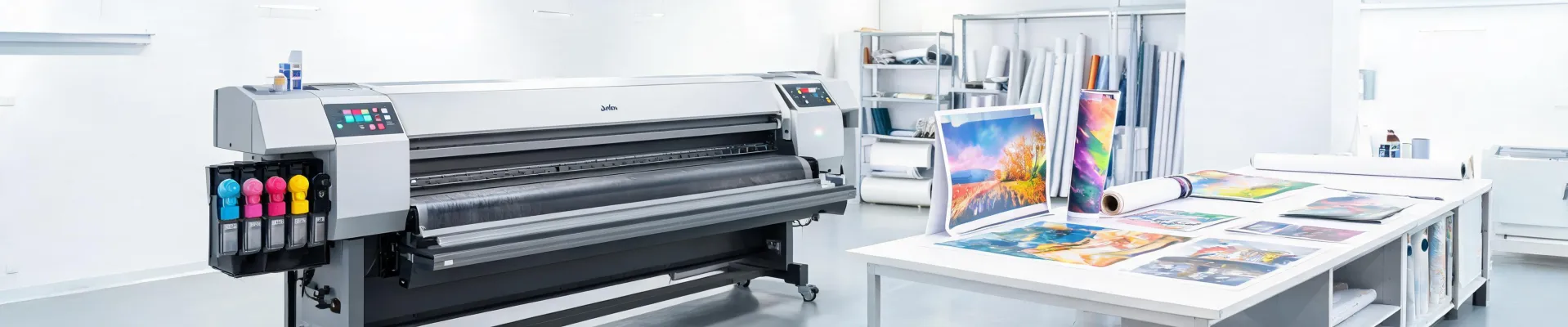
Printer Breakdowns Aren't Really About the Printer
2026-08-12 · Elise Marceau
In March 2024, I got a call at 4:17 p.m. A client needed 300 production pieces for an event that opened in 36 hours. Normal turnaround would have been five days. We found a way — overnight freight, a backup shop, and a lot of fast decisions.
That isn't really a story about a printer breaking down. It's a story about the support system around the printer. In my role coordinating production for a wide-format and garment-decorating shop, I've handled 200-plus rush orders in six years, including same-day turnarounds for event clients. When the phone rings at 4 p.m. on a Thursday, the machine is rarely the root cause.
The problem everyone blames first
If an industrial printer stops printing, the obvious fix is to fix the printer. I get why that's the first reaction — budgets are real, deadlines are real, and the machine is right there. But after years of watching production floors, I'd argue the obvious problem is often the shallow one.
The most frustrating part of printer failures: they're never convenient. You'd think a $40,000 machine could at least fail at the end of a shift, but it waits until a client has already promised delivery. The printer is the messenger, not the message.
Missing that deadline would have meant a $50,000 penalty clause. The printer was just the messenger.
Why it actually goes wrong
Digging into the failures I've seen, the same four causes show up again and again.
1. The machine sent warnings before it stopped
The most common pattern is not sudden death. A printhead starts dropping nozzles. A carriage guide gets dirty. Banding appears on one roll of vinyl. Cleaning cycles take longer than they used to. These are warnings, but when the job is due tomorrow, it's easier to ignore them.
When I'm triaging a rush order, I don't ask what the warranty covers. I ask what spare parts can be here by tomorrow morning. The warranty length doesn't matter if the nearest authorized technician is 400 miles away and the part ships ground. (note to self: this is the part I keep forgetting when I'm in the middle of a rush.)
2. Support is the forgotten half of the purchase
Mutoh support is a good example. Authorized technicians who work on the XpertJet C641SR Pro know its specific quirks — printhead alignment, ink line deaeration, pinch roller tension, media feed calibration. A generic repair service can guess. Guessing costs days.
What most people don't realize is that factory support isn't just a phone number. It's remote diagnostics. It's a regional parts warehouse. It's a technician who shows up with a printhead kit instead of a diagnostic fee and a promise to order the part.
3. Upfront price hides the cost of almost
This is where I want to be fair. A KingJet DTF printer or a Funsun A3 UV printer can be a reasonable entry tool for a small shop. To be fair, some shops run them profitably for years. The output can surprise you.
But the price you see is only the beginning. With a budget DTF printer, ask: where is the nearest technician, how fast can a printhead ship, does the seller provide a schematic, and is the firmware locked? With a Funsun A3 UV printer, ask the same questions. If a printhead dies during a 1,000-piece order, cheap stops being cheap very quickly.
From my perspective, that's why Mutoh support shows up in my conversations more often than print quality. It's not about brand loyalty. It's about response time.
4. The inkjet printer hazards that don't make headlines
The other part of the cost is health, and it's one of the most ignored inkjet printer hazards in production shops. A UV flatbed uses liquid ink that cures under high-intensity light. Uncured UV ink is a skin and eye sensitizer. Solvent and eco-solvent inks release VOCs. DTF adhesive powder can hang in the air as fine dust.
Under OSHA's Hazard Communication Standard (29 CFR 1910.1200), every ink and powder supplier must provide a Safety Data Sheet. If a seller can't produce one before you place an order, that's a red flag. And if an ink is labeled green or low-VOC, the FTC Green Guides require measurable proof (ftc.gov). Don't let a label do the risk assessment.
I'm not a safety consultant, but I've seen a minor skin irritation turn into contact dermatitis because nobody took the SDS seriously. That is also downtime.
What fix it later actually costs
Let me put some numbers around it. When a printer fails with no plan, the true cost has four layers:
- Rush fees. Expedited freight, overtime labor, outside production at double pricing (like $800 in overnight shipping to save a $12,000 project).
- Lost contracts. One late delivery can move a steady client to a competitor permanently.
- Safety incidents. A chemical exposure or an electrical short from a DIY repair can stop the entire floor for an investigation.
- Opportunity cost. Every hour you spend finding an emergency solution is an hour you're not quoting new jobs.
Last quarter, we processed 47 rush orders with 95% on-time delivery. The 5% miss wasn't a technology problem. It was a support gap.
What I'd do differently next time
The solution isn't to buy the most expensive printer and hope. The solution is to buy the support system that keeps production predictable.
- Budget for support before you budget for hardware. In my opinion, 10–15% of the purchase price should go to installation, training, spare parts, and a service contract. For the Mutoh XpertJet C641SR Pro price, that means the real investment is more than the quote.
- Ask for a response-time guarantee. If the printer is down, can a technician be on site in 24 hours? Are critical parts stocked locally?
- Run a worse-case drill. Take one of your real jobs and ask: if the primary printer died today, what's the recovery path? If you can't answer in 10 minutes, build one.
- Write down the safety checklist. Ventilation on, PPE available, SDS sheets accessible, emergency shutoff tested. The boring stuff is the stuff that saves you.
And update your old assumptions. What was best practice in 2020 may not apply in 2025. DTF and UV are no longer side experiments; they're daily production tools. The fundamentals — cleanliness, environment, spare parts, support — haven't changed. But the execution has transformed.
As for pricing, I'm not 100% sure where the market is heading, but as of Q1 2025, the configured quotes I've seen for a Mutoh XpertJet C641SR Pro sit roughly in the $30,000 to $40,000 range before installation, training, and initial ink. That was accurate when I wrote it. Printing equipment changes fast, so verify current pricing and support terms before you commit.
There's something satisfying about watching a rushed order leave the loading dock on time. After the stress, the coordination, and the backup plan, that's the payoff. But it's easier to feel that when the printer isn't the thing that almost took you down.

Elise Marceau
Elise Marceau is an LED display and digital-signage systems analyst covering LED video walls, modular screens, transparent LED, control processors, and indoor or outdoor signage. She applies IEC 62368-1 safety principles while comparing pixel pitch, luminance, contrast, refresh rate, colour uniformity, viewing angle, ingress protection, power density, module serviceability, and signal redundancy. Her specification guides help integrators, venue operators, retailers, and procurement teams align viewing distance, ambient light, content format, installation access, electrical load, and lifecycle support.