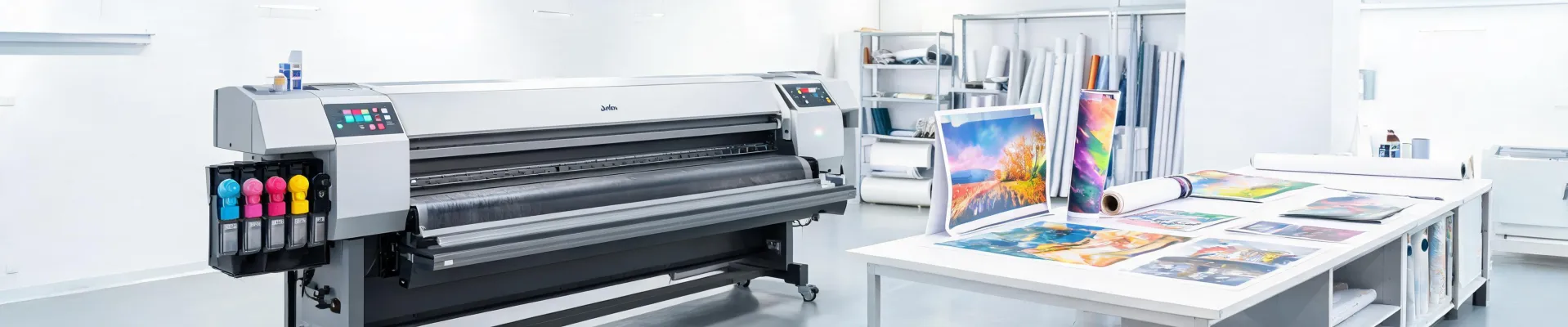
Mutoh XpertJet 461UF Flatbed UV-LED Printer vs Mutoh Sublimation Printer: A Buyer's Comparison
2026-08-25 · Elise Marceau
The comparison: two different workflows
Stop thinking of this as 'one is better.' It's a workflow decision.
A Mutoh XpertJet 461UF flatbed UV-LED printer prints directly onto rigid and flexible media. You load a board, print, the LED pins the ink, and the part is done. A Mutoh sublimation printer prints onto transfer paper, then you heat-press that paper onto polyester-based fabric or coated hard goods. Same family, very different production line.
The comparison that matters is not 'which prints better.' It's 'which one fits the production line you already have, or the one you're trying to build.'
Media and workflow: the first dimension
If you walk our shop floor on a Tuesday, you'll see 6 acrylic signs, 12 corrugated boards, and a stack of polycarbonate labels. That is exactly where a flatbed UV printer earns its keep.
The 461UF's flatbed gives us table stability for rigid media. We can gang multiple 11x17s on the bed without buying a separate cutter. The print cures with LED, so there's no drying rack, no waiting for solvent to off-gas, no extra step before lamination.
A Mutoh sublimation printer, by contrast, needs transfer paper, a heat press, and the right polyester-coated material. If you're set up for dye-sublimation on fabric or promotional products, it's a complete solution. If you're not, you're buying a whole additional process—not just a printer.
But here's where I surprised myself. Everything I'd read about dye-sublimation made it sound like a lower-cost print method. It is, on long runs of polyester fabric. But for short-run rigid pieces, the transfer paper, pressing labor, and rejected parts from shifted transfer can cost more than the straightforward UV print. That was my experience override: the 'cheaper' workflow was not always cheaper once I counted the labor.
One detail that matters for print shops doing direct mail: USPS defines a large envelope, or flat, as up to 12 x 15 inches with a maximum thickness of 0.75 inch (Source: USPS Business Mail 101, usps.com). So an 11x17 job can be printed directly on a rigid board and still meet mailing size—if it's under the thickness limit. A sublimation printer can't do that without an extra substrate step. Not a reason to buy anything, but useful when a salesperson says 'media doesn't matter.'
Conclusion: If your work is rigid signs, packaging, labels, or short-run specialty pieces, the flatbed UV wins this dimension. If your work is polyester apparel, soft signage, or custom goods with funky shapes, a sublimation printer wins.
Color accuracy: what 'best 11 x 17 inkjet printer color accuracy 2025' gets wrong
I keep seeing searches for 'best 11 x 17 inkjet printer color accuracy 2025.' Anyone in buying can type that query. The trouble is, 'color accuracy' on an 11x17 proof sheet is not the same as 'color accuracy' across a production run.
The Mutoh XpertJet 461UF flatbed UV-LED printer uses UV-cured ink that doesn't soak into the substrate the way dye inks do. On a hard, non-porous surface, color stays closer to the proof. The same image on glossy acrylic will look different from the same image on matte board, but repeatability from job to job is high—provided the printer is maintained and you're running Mutoh inks, not generic refills. I'm not a technician, but I've seen a generic ink bottle turn that repeatability into a three-hour phone call.
A Mutoh sublimation printer's color accuracy, on the other hand, depends on the transfer paper, heat press temperature, dwell time, and the polyester coating on the item. I've watched two 'identical' dye-sub mugs come out one shade apart because the press temp drifted. That's not a printer failure; it's process variance. That's why I ask our operators to log press settings before approving any large dye-sub order.
So my answer to the 'best 11 x 17 inkjet printer color accuracy 2025' question is: if you're proofing on an 11x17 sheet, you probably don't need a 46-inch production flatbed or a 64-inch dye-sub. You need a small calibrated inkjet and a spectrophotometer. But if you're printing production parts, the XpertJet 461UF is more predictable on rigid media than dye-sub is in a manual transfer process. That's not the intuitive answer, but it's what I've seen after five years of watching both workflows.
Service, spares, and the real purchase price
This is the dimension where I sound like a purchasing person, because I am one.
When I took over in 2020, I inherited a UV printer service contract that listed 'parts' as included. The first major service call after 14 months came back with a separate invoice for dampers. The vendor had not said 'parts' excluded wear items. That little omission cost us $2,400 in unplanned spend.
Now, before I sign any equipment quote, I ask three things:
- What is NOT included?
- What is the average response time for uv printer service?
- Which parts are considered wear items?
For a Mutoh XpertJet 461UF flatbed UV-LED printer, wear items from the service quotes I've reviewed often include printheads, dampers, and sometimes the UV lamp assembly. That's not a criticism; it's reality. A flatbed UV printer is a machine with moving parts, ink lines, and a curing system. It will need service. The question is whether your vendor is transparent about that before the sale.
A Mutoh sublimation printer also needs regular maintenance—head cleaning, firmware updates, and a well-calibrated heat press. But dye-sub shops sometimes forget that the press is part of the system. If you're buying a wholesale inkjet printer for a new dye-sub line, budget for the press, the paper, and the training upfront.
I've learned to ask 'what's NOT included' before 'what's the price.' The vendor who lists all fees upfront—even if the total looks higher—usually costs less in the end. If a salesperson can't explain their service process, I treat that as a red flag. If they describe their service contract as 'too complex to summarize,' I know the invoice later will include surprises.
Per FTC guidelines (ftc.gov), environmental claims need to be substantiated. So when a vendor says 'the UV ink is eco-friendly' or 'this media is recyclable,' I ask for the test report. If they can't produce it, that's not a green claim; that's a marketing claim I have to bounce back to procurement.
One more buying lesson: a vendor who couldn't provide a proper invoice for spare parts—handwritten receipt only—once cost us $2,400 in rejected expenses because finance would not approve it. Now I verify invoicing and service capability before placing any order.
Choosing after the comparison
So which one should a print shop choose? It depends on what you're already doing and what the next customer actually asks for.
- Choose a Mutoh XpertJet 461UF flatbed UV-LED printer if most of your work is rigid, 3D, or mixed substrates—acrylic, board, PVC, aluminum, or direct-to-object label runs. You get one machine, a flatbed, and a straight path to a finished product.
- Choose a Mutoh sublimation printer if your core revenue is polyester fabric, apparel, soft signage, or promotional products that go through a heat press. You're buying a process, not just a printer, and you'll need the press and workflow to match.
- If your operation is a true hybrid, buy the one that solves the biggest production bottleneck first. Don't buy two printers at the same time unless you have the staff to service them.
A note on 'wholesale inkjet printer' purchasing: the unit price is the least interesting number on the quote. Your real costs are media handling, spare parts, operator time, downtime, and the phone call to a technician who doesn't show up until Thursday. I've seen a 5% price difference between two quotes disappear when the cheaper vendor added a hidden setup fee and a higher hourly rate for service.
The transparency lesson
I can only speak to our operation—a 40-person shop in the Midwest with predictable ordering patterns. If you're a trade printer running 50 orders a day, or a brand-new shop trying to do everything, the math might be different. But the principle is the same: ask the 'not included' question, get the service checklist, and inspect the print line before you sign.
The Mutoh XpertJet 461UF flatbed UV-LED printer and Mutoh sublimation printer are both reliable tools in their proper roles. The one that works for you is the one that matches your actual production process—and comes from a dealer willing to show you the whole cost, not just the sticker.
Pricing and service terms change, so verify current details with an authorized Mutoh dealer or service provider before making a decision.

Elise Marceau
Elise Marceau is an LED display and digital-signage systems analyst covering LED video walls, modular screens, transparent LED, control processors, and indoor or outdoor signage. She applies IEC 62368-1 safety principles while comparing pixel pitch, luminance, contrast, refresh rate, colour uniformity, viewing angle, ingress protection, power density, module serviceability, and signal redundancy. Her specification guides help integrators, venue operators, retailers, and procurement teams align viewing distance, ambient light, content format, installation access, electrical load, and lifecycle support.