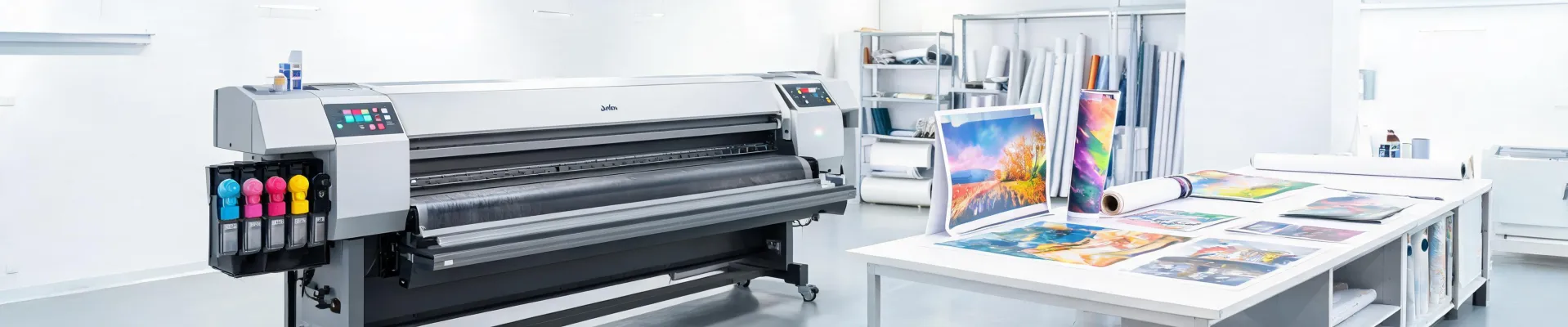
A Quality Inspector’s Take: Don’t Buy a Mutoh Printer for Sale Until You Can Answer These Questions
2026-08-25 · Elise Marceau
Let me get one thing out of the way: I’d rather spend ten minutes explaining why a printer is or isn’t right for you than process a fast order and then get the angry call three months later. That call is almost always the same. The prints look wrong. The error code doesn’t match the manual. The substrate you bought was never designed for the ink. And the first sentence usually is, “But the spec sheet said…”
I say this as a quality and brand compliance manager at a wide-format equipment dealership. I review every machine that leaves our floor—roughly 200 units a year. In 2024, I rejected about 6% of first deliveries because of shipping damage, misconfigured firmware, or test prints that didn’t match what the customer ordered. That number taught me something: the risk isn’t the sales moment. The risk is everything that happens after installation.
Everything I’d read about printer buying said that speed and resolution are king. My experience says the opposite. A machine with strong support will outperform a faster machine with nobody behind it.
Honestly, if you’ve ever watched a deadline slip because a consumable is on backorder, you know exactly what I’m talking about. The spec sheet doesn’t tell you what it feels like when a replacement part takes two weeks.
The Spec Sheet Is Not a Business Plan
When someone asks about a Mutoh printer for sale on our floor, my first question is not “What’s your budget?” It’s “What are you going to print, and what does your week look like?” A printer is not an accessory. It is a workflow. The right workflow depends on whether you are doing long unattended runs, short color-critical jobs, or a mix of substrates.
Here’s what I check before I even talk about hardware: Can you get replacement parts in your region? Does the supplier offer training? Are the manuals written for operators or engineers? What is the recommended maintenance cycle? How long can the machine sit idle before the printheads need attention? Those are the questions that predict success. Speed specs only predict the fastest possible failure mode.
What a Quality Checklist Tells You
I’ve been doing this long enough to know that every machine needs to be checked before it goes out. A Mutoh printer cutter, for example, seems straightforward: print, then cut the contour. But I’ve seen a 50-foot roll of vinyl become scrap because someone skipped the registration mark test after changing a printhead. The machine was fine. The process was broken. (The operator didn’t read the updated guide, unfortunately.)
That’s why I don’t put much faith in “set it and forget it” promises. No industrial printer is set-and-forget. It’s a relationship between the operator, the media, the ink, and the environment.
The Entry-Level Question: Vevor DTF Printer
I get asked about the Vevor DTF printer a lot. Let’s be straight: I’m not going to tell you it’s garbage. For a small shop that wants to learn DTF without spending a fortune, it can be a useful starting point. The problem begins when it’s treated as a production machine.
Some questions I ask in that situation: Can you get a printhead within two days? Is there a dedicated support number? Are the consumables documented? If the answer is “I don’t know,” that’s a red flag. The purchase price is a down payment on a workflow. In a peak season, a week of downtime costs far more than the money you saved on the printer. I’ve seen that math play out more than once.
I weighed that same math when our shop considered a no-name machine from an online marketplace. The upside was enough savings to buy spare printheads. The risk was losing two weeks waiting for a part while client jobs backed up. I kept asking myself: is the savings worth potentially missing a deadline? It wasn’t. (Should mention: we eventually bought from a channel that had local stock and actual support.)
Applications Should Drive the Choice
This is where customer education matters most. People often search for “UV printer acrylic printing” because they’ve seen beautiful acrylic samples. UV printing on acrylic can look incredible. It can also peel if you don’t manage adhesion. Acrylic is smooth and non-porous. Without pre-treatment or the right ink/curing profile, the first run might look fine, then fail days later.
I’ll admit to my own shortcut here. In my first year, I skipped a quick adhesion test because it was “basically the same material we used last time.” It wasn’t. The ink delaminated overnight. That’s the kind of mistake that costs an $18,000 redo and makes you read the test manual very carefully from then on.
It took me about four years and a few hundred installs to understand that no machine is self-sufficient. Every successful print shop has a system for testing, training, and maintaining the environment. The hardware is only one component.
The same applies to “sublimation printer products.” That phrase isn’t about one product. It’s a system: a dye-sublimation printer, sublimation ink, transfer paper, heat press, and polymer-coated blanks. Change one element, and colors shift. I’ve seen a customer blame a printer when the actual issue was the coating on the blank. The person who understands the system asks better questions before ordering, and that makes for a much better outcome.
Support and Parts Are the Real Features
If you’re comparing a Mutoh printer for sale to a cheaper option, look closely at what’s behind the printer. Mutoh’s lineup spans UV flatbed, eco-solvent, DTF, DTG, and sublimation. That breadth matters because it means the manufacturer has a serious investment in service infrastructure. But even with a strong brand, the dealer and support network make the final difference.
Actually, I should add: I’ve seen hesitant buyers choose a Mutoh printer for sale and second-guess themselves until the machine produced a clean test print. The anxiety was real. The good news is that a proper validation process takes care of it.
I won’t promise that any printer will never break. That would be a lie. I will say that a good support channel is worth more than a few extra inches per second on the spec sheet. (As of early 2025, this is still the part that protects my sleep.)
And One Compliance Warning
There’s another layer to customer education: claims. Per the FTC’s Green Guides (ftc.gov), if you market an ink or media as “eco-friendly” or “recyclable,” you need to be able to substantiate it. I’ve seen a proposal get delayed because a material spec said “biodegradable” without any proof. In B2B printing, this isn’t an afterthought. It’s part of the buy decision.
What About “Learn as You Go”?
I know a common view: start small, make mistakes, grow. I respect that. For side projects and light testing, a smaller setup can be a smart move. But “learn on the job” is a dangerous strategy when the machine is connected to customer deadlines. Every failed run is not just a learning experience; it’s a missed delivery and a hit to your reputation.
So here’s my bottom line. If you’re looking for a Mutoh printer for sale, a Mutoh printer cutter, a Vevor DTF printer, or any other machine, ignore the urge to make a fast decision on spec sheets alone. Ask about training and support. Ask to see real samples on your target substrates. Ask what happens when something goes wrong after the first month. An informed customer is the best customer. That’s not a slogan—it’s what I’ve learned by rejecting machines, writing complaints, testing prototypes, and watching what actually works in the real world.
Take it from someone who has rejected deliveries for a living: the best printer for you is the one you understand before it arrives. Everything else is just hardware.

Elise Marceau
Elise Marceau is an LED display and digital-signage systems analyst covering LED video walls, modular screens, transparent LED, control processors, and indoor or outdoor signage. She applies IEC 62368-1 safety principles while comparing pixel pitch, luminance, contrast, refresh rate, colour uniformity, viewing angle, ingress protection, power density, module serviceability, and signal redundancy. Her specification guides help integrators, venue operators, retailers, and procurement teams align viewing distance, ambient light, content format, installation access, electrical load, and lifecycle support.