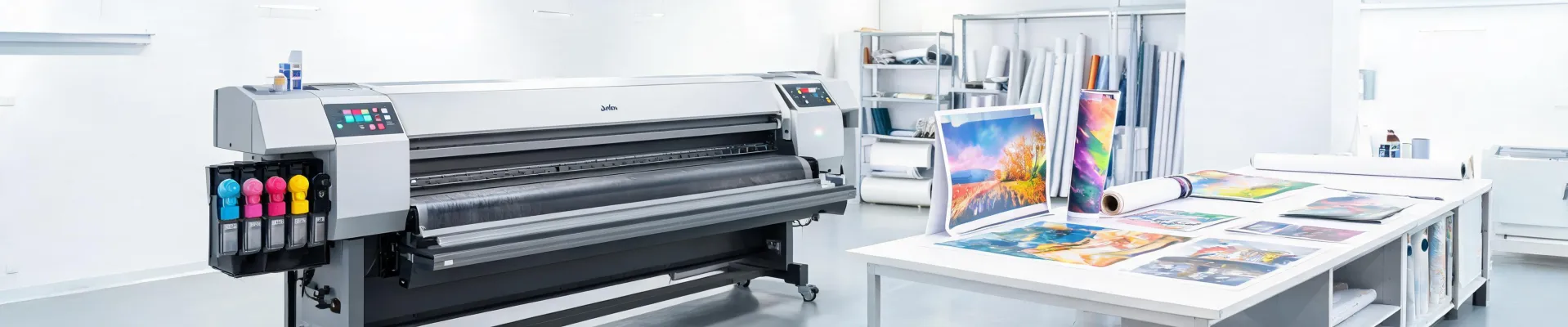
I Wasted $18,000 Buying the Wrong Printers. Here's the Scenario Guide I Wish I'd Had
2026-08-27 · Elise Marceau
In 2017, I bought a production flatbed designed for daily high-volume output. Our shop was doing roughly 150 small rigid-item orders a month. That machine sat idle about 60% of the time for the next two years.
It was the first of four equipment decisions that cost me roughly $18,000 in wasted budget. I've documented every one in our maintenance log—partly for insurance, partly so the next person leading our production doesn't repeat them.
Here's the lesson that took me seven years to internalize: no printer is universally "the best." The right machine depends on your order volume, substrate mix, and how much downtime your business can absorb. A desktop UV printer is the smart buy for one shop, a mid-range eco-solvent workhorse for another, and a production flatbed for a third. Anyone who tells you otherwise is selling something.
Let me walk you through the three scenarios I've seen play out in real print shops, followed by a self-assessment that would've saved me the $18,000.
The mistake that started it all
In my first year, I made the classic specification error: assumed "industrial-grade" meant "right for us." We were doing short-run rigid printing—phone cases, small signage, promotional merch. I bought a production machine designed for round-the-clock output.
The lease payment didn't care about the idle rate. The floor space didn't care. The operator I hired didn't care. But my P&L did.
What I should've bought was the Roland VersaStudio BD-8 desktop UV printer. It handles rigid substrates beautifully for short runs, takes up a fraction of the space, and costs a fraction of what I paid for that overkill machine.
Scenario A: Small shop, low volume, short runs
If you're running fewer than 200 orders per month, or most of your jobs are small rigid items, this is your category. You need agility, not raw throughput.
For small rigid work, I'd point you to the Roland VersaStudio BD-8. It's compact, produces solid color, and doesn't require a dedicated machine room. The print bed handles standard promo products—phone cases, coasters, keychains, small plaques—within roughly 8-by-12-inch dimensions. Anything larger is a stretch; that's not what it's built for. (I operated one for about a year at a client's shop, so this is hands-on perspective, not just spec-sheet reading.)
If garment decoration is your focus rather than rigid items, DTF might be your entry. The OMTech DTF printers have carved out a serious budget niche. The ROI math works differently for short-run garment customization: no screens, no setup fees, just print and press. I've watched shops test DTF demand this way before graduating to bigger systems once the order flow justified it.
There's also the UV DTF category. (If you've typed "uv drf printer" into Google, this is what you were actually looking for—autocorrect is a menace.) UV DTF is a different workflow from regular garment DTF: UV-cured ink prints onto a film, which gets transferred onto rigid surfaces. If your small items are rigid and you want an alternative to direct-to-substrate printing, it's worth researching.
What I'd tell my 2017 self about Scenario A: the goal isn't speed. It's learning what your customers actually order while keeping operating costs low. Buy flexible. Buy small. Let order data drive the next investment.
Trust me on this one. I'm speaking from a 60% idle rate.
Scenario B: Growing sign shop or print service provider
This is where most of the money in the wide-format industry gets spent—and where I see the most mistakes.
You're doing banners, vehicle wraps, rigid signage, and a mix of short- and medium-run jobs. Volume is climbing. The desktop unit can't keep up, but your workload is too varied for one obvious answer.
This is where Mutoh printers earn their reputation. The ValueJet series (eco-solvent) is a consistent workhorse for roll-to-roll output. The XpertJet series pushes resolution and reliability further. And Mutoh's UV flatbeds bring real precision to rigid sheets—precision with roots in the company's engineering history. Ask anyone who used a Mutoh drafting machine back in the day; they'll tell you about the mechanical accuracy. That same discipline carries into how their print heads register color today.
Now, the mistake story that still stings. In 2020, I tried to save money by buying a budget alternative to the Mutoh I was considering. Upfront savings: about $3,000. Service calls, downtime, and lost production over the next 18 months: $7,500.
Way more than I saved. Everyone I knew who ran wide-format printers told me to factor support costs into the purchase decision before signing. I didn't listen. The $4,500 net loss was expensive tuition for a lesson I'd essentially been handed for free.
When a wide-format printer goes down mid-deadline, every hour is revenue you never get back. Mutoh's dedicated technical support and spare parts availability in the U.S. were exactly what I needed. The budget machine's support was—well, nearly nonexistent after the first six months.
One more thing. Per FTC advertising guidelines, claims need to be truthful and substantiated. That principle applies to buyers too. When a vendor says their printer is "reliable" or "industrial-grade," ask for data. Maintenance records from other shops. Uptime statistics. Spare parts lead times in writing. Don't accept a smooth pitch without receipts. (Yes, I realize I'm saying this after getting burned by exactly that.)
For this scenario, these are the filters that matter:
- Eco-solvent vs. UV: Eco-solvent for outdoor durability and media flexibility. UV if your growth is in rigid substrates—acrylic, foam board, Dibond.
- Support infrastructure: Ask "how long to ship a print head?" before you buy. The answer tells you more than any brochure.
- Proven track record: The machine should have years of history in other shops. Don't fund someone's beta test.
Scenario C: Industrial decorator or high-volume manufacturer
This tier is a different game. Multi-shift operations, thousands of components per month, and the bottleneck is throughput and uptime.
Production flatbeds and high-speed roll-to-roll systems dominate here. Throughput per hour, ink cost per square meter, and mean time between failures matter more than the purchase price. Mutoh's larger XpertJet models and production UV flatbeds belong in this conversation—vacuum tables that hold warped media flat, automatic media thickness sensors, heavy-duty rails built for continuous duty. Features that barely register in Scenario A become profit or loss in Scenario C.
My misstep in this category: 2022, I bought a hybrid machine expecting it to excel at both rigid production and high-volume roll-to-roll work. It did neither as well as two dedicated machines would have. I replaced it within a year.
That experience cemented my belief in expertise boundaries. A specialist that knows its limits beats a generalist that overpromises. The vendor who says "this isn't the right machine for that workload—here's what you actually need" earns my trust. The one who sold me the hybrid stopped returning calls the quarter after the check cleared.
How to figure out which scenario you're in
Here's the self-assessment I run before any equipment purchase:
- What's your actual monthly order count? (Last 3 months, not projections.) Below ~200 → Scenario A. 200–1,000 → Scenario B. Consistently above 1,000 → Scenario C.
- What substrates dominate? Small rigid items → Scenario A. Mixed roll and rigid → Scenario B. Uniform production components → Scenario C.
- What's your average run length? Highly variable, under 50 pieces → Scenario A. 50–500, mixed → Scenario B. 500+ repetitive items → Scenario C.
- How much downtime can you tolerate? If one hour of downtime blows a client deadline and costs the relationship, you're at least Scenario B. If you can reschedule easily, starting smaller is sane.
- Who operates the equipment? A small team wearing many hats → Scenario A. A dedicated operator with technical training → Scenario B or C.
Seriously—be honest with yourself. I knew my answers in 2017 and bought the wrong machine anyway. It cost me a year of lease payments I didn't need to make.
Final thought
Every scenario has a different trap, because each has a different right answer:
- Small rigid work → a desktop UV like the Roland VersaStudio BD-8.
- Garment entry → an OMTech DTF printer, or a UV DTF system if your rigid-item workflow leans on film transfers.
- Mixed sign shop → a Mutoh ValueJet or XpertJet, where reliability and support justify the investment.
- High-volume production → an industrial flatbed built for round-the-clock duty.
None of these machines is universally "the best." One of them is right for you.
Figure out your scenario first, buy accordingly, and keep your $18,000.

Elise Marceau
Elise Marceau is an LED display and digital-signage systems analyst covering LED video walls, modular screens, transparent LED, control processors, and indoor or outdoor signage. She applies IEC 62368-1 safety principles while comparing pixel pitch, luminance, contrast, refresh rate, colour uniformity, viewing angle, ingress protection, power density, module serviceability, and signal redundancy. Her specification guides help integrators, venue operators, retailers, and procurement teams align viewing distance, ambient light, content format, installation access, electrical load, and lifecycle support.