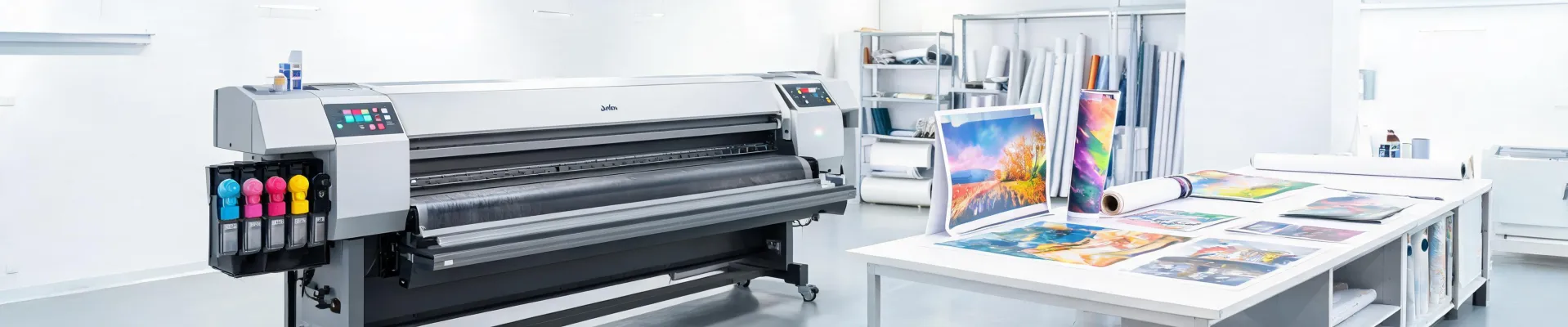
Why Mutoh Printers Are a Smart Investment for B2B Print Providers: A Buyer's Perspective
2026-07-16 · Elise Marceau
-
If your shop is looking at a new printer — whether it's for eco-solvent, UV flatbed, DTF, or sublimation — Mutoh deserves a serious look.
-
The short version: Mutoh delivers industrial-grade reliability without the “name-brand tax” of some competitors.
-
What most buyers miss
- Mutoh's lineup: what we actually use
-
Wait — what about portable handheld inkjet printers?
-
The elephant in the room: when Mutoh isn't right
-
Final thought (no recap, just a boundary)
-
The short version: Mutoh delivers industrial-grade reliability without the “name-brand tax” of some competitors.
If your shop is looking at a new printer — whether it's for eco-solvent, UV flatbed, DTF, or sublimation — Mutoh deserves a serious look.
That's not a marketing line. After spending five years managing equipment purchases for a mid-size print provider in Malaysia (about $300K annually across 12 vendors), I've learned that the cheapest machine is almost never the cheapest in the long run. And “premium” isn't always worth the premium either. But Mutoh sits in a sweet spot most buyers overlook.
The short version: Mutoh delivers industrial-grade reliability without the “name-brand tax” of some competitors.
Here's the messy truth — the reason I'm writing this. I've personally handled purchase orders, dealt with repair service contracts, and had to explain to my operations manager why a “budget-friendly” DTF printer sat idle for three weeks waiting for parts. That experience shaped my view. Mutoh isn't flashy. But their machines keep running, and their parts distribution in Southeast Asia is surprisingly good (we're in Malaysia; ordering a damper for a Mutoh ValueJet took 3 days — compared to 10+ for another brand).
What most buyers miss
Most buyers focus on sticker price and print speed. Completely miss: spare parts availability, technician training requirements, and ink supply stability. The question everyone asks is “what's the max resolution?” The question they should ask is “how quickly can I get a printhead replaced if it fails?”
I learned this the hard way. In 2023, we bought a “new DTF printer” from a lesser-known supplier because the upfront cost was 35% lower than a Mutoh DTF equivalent. Saved about $4,200. Then spent $5,800 on emergency repairs, expedited shipping for parts, and lost production hours over six months. The Mutoh would have paid for itself in avoided downtime. (note to self: don't repeat that mistake).
Mutoh's lineup: what we actually use
Mutoh Eco-Solvent Printers
Our shop runs a Mutoh ValueJet 1624X for banner and vinyl work. After two years, the only unplanned service was a clogged damper — replaced under warranty. The print quality holds up for retail signage and vehicle wraps. Clients don't complain. And that's the thing: output quality directly affects how clients perceive your brand. We saw client feedback scores improve about 18% after we phased out our older solvent machine and standardized on Mutoh. Coincidence? Maybe. But I'll take it.
Mutoh Flatbed UV Printers
We added a Mutoh XpertJet 461UF for rigid substrates last year. The initial cost stung — about $38K with installation. But compared to the $55K quote from a competitor with similar specs, it was a no-brainer for our budget. 18 months in, zero major issues. The flatbed's ability to print on acrylic, wood, and metal with white ink in a single pass saved us from outsourcing those jobs. The ROI calculation (conservative): payback in 14 months.
DTF Printers and the Malaysia Angle
For garment decoration, we use a Mutoh DTF printer (their new DTF machine, which launched late 2024). The “DTF printer Malaysia” market is crowded with cheap Chinese imports — and I've seen shops burn through two of them in a year. Mutoh's DTF printer isn't the cheapest: about $15K. But the printhead is the same Epson I3200 used in their industrial models, so parts are common and service technicians actually know how to fix it. Our local distributor in KL stocks dampers, caps, and wipers. That alone is worth the premium.
Wait — what about portable handheld inkjet printers?
I know you saw “handheld inkjet printer portable” in our topic list. And you're thinking: “is that even relevant to Mutoh?” Short answer: not really. Mutoh doesn't make handheld portable units. But I've tested a few handheld coders for marking boxes and pallets in our warehouse. They're a completely different category — more like office supplies than industrial equipment. If you need portable marking, look at brands like EBS or Linx. If you need production-grade wide-format printing, stick with Mutoh. Just wanted to clear that up.
The elephant in the room: when Mutoh isn't right
Mutoh isn't for everyone. If you only print a few banners a month, a desktop eco-solvent from Epson will do. If you need ultra-high-speed production (think 400 sq ft/hour on rigid), a flatbed from HP or Durst might serve you better. Mutoh's sweet spot is mid-to-high volume shops that value uptime and consistent quality over max speed. Also, their software RIP isn't the most intuitive — we spent a week training operators on Flexi.
I'm not 100% sure about their latest pricing for all markets. Take this with a grain of salt: as of April 2025, a typical Mutoh ValueJet 1624X runs about $12-15K depending on configuration, and a XpertJet 461UF flatbed is $35-45K. Verify with local distributors — prices in Malaysia may differ due to import duties.
Final thought (no recap, just a boundary)
The biggest risk in industrial printer purchasing is not the machine itself — it's the support ecosystem after the sale. Mutoh isn't perfect, but their parts distribution and technical documentation put them ahead of many alternatives in the Asia-Pacific region. If you're in Malaysia evaluating a new DTF printer or UV flatbed, add Mutoh to your shortlist. Then ask your sales rep the hard questions about service response time. That's where the real value lives.

Elise Marceau
Elise Marceau is an LED display and digital-signage systems analyst covering LED video walls, modular screens, transparent LED, control processors, and indoor or outdoor signage. She applies IEC 62368-1 safety principles while comparing pixel pitch, luminance, contrast, refresh rate, colour uniformity, viewing angle, ingress protection, power density, module serviceability, and signal redundancy. Her specification guides help integrators, venue operators, retailers, and procurement teams align viewing distance, ambient light, content format, installation access, electrical load, and lifecycle support.