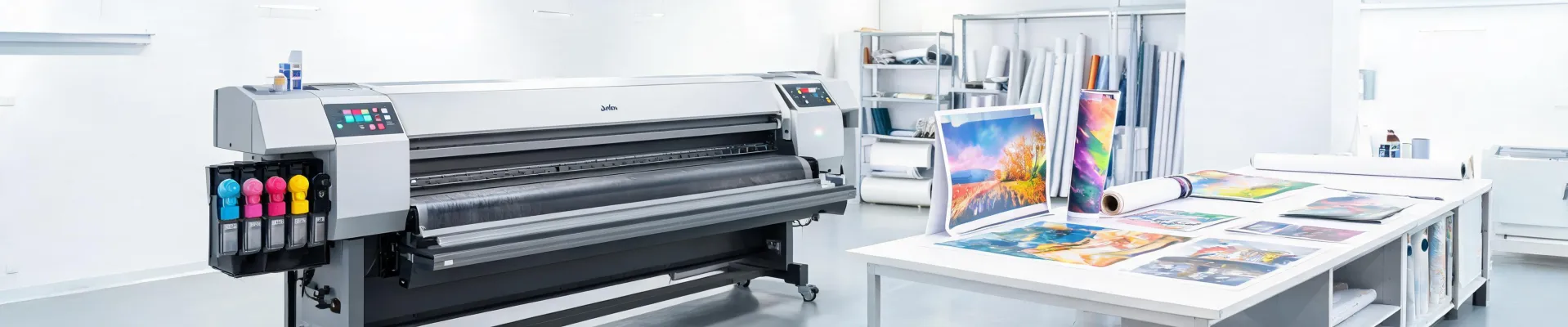
Is a Mutoh Large Format Printer or a DTF Setup Right for You? A Cost Controller’s Scenario Breakdown
2026-07-24 · Elise Marceau
If you're reading this, you've probably typed some version of these into Google:
- “Mutoh large format printer”
- “i1600 DTF printer”
- “DTF L805 printer”
- “Can you use laser printer for sublimation”
And maybe you're wondering which machine is the answer. I've been there. Over six years of managing procurement for a mid-size print shop, I've tracked every invoice, every hidden fee, every reprint that ate into our margins. I've made expensive mistakes so you don't have to. Here's the thing: there is no universal best printer. The right choice depends entirely on your stage, your volume, and your tolerance for risk. Let me walk you through three common scenarios.
Scenario A: You're Starting a DTF Business from Scratch
You're looking at the Mutoh i1600 DTF printer or maybe the DTF L805 printer. Both are popular entry points, but they're fundamentally different beasts.
The i1600 DTF is a dedicated DTF solution from Mutoh—industrial-grade, designed for high-volume production. It uses Mutoh-specific printheads and parts, which means you're buying into an ecosystem. Mutoh printer parts are widely available, but they're not cheap. On the flip side, the build quality is proven. I've seen shops run these things 12 hours a day for two years with only routine maintenance.
The L805 DTF (often an Epson-based conversion) is a lower upfront cost—like $600-800 for the base printer versus $10,000+ for the i1600. But here's where TCO bites you. I almost made this mistake myself. A year ago a colleague was hyping his L805 DTF setup: “$700 printer, $200 conversion kit, printing like crazy.” Sounded great. Until I dug into his numbers at a trade show.
“I knew I should calculate the cost per print before buying, but thought 'how bad could it be?' Well, the odds caught up with me when I realized my tiny printhead was barely lasting 3 months. Replacing it cost $250 each time. Plus the constant clogs and misalignment—I was losing 15% of my production to re-dos.”
His TCO over 18 months:
- Printer + conversion: $900
- Printhead replacements (6 times): $1,500
- Lost media & ink from rejects: ~$1,200
- Downtime labor: ~$2,400 (his estimate)
- Total: $6,000
Meanwhile, a shop using the i1600 DTF paid $12,000 upfront, but over the same period their additional costs were:
- 1 printhead replacement (still under warranty): $0
- Routine parts (dampers, wipers): $400
- Lost media from rejects: ~$300
- Downtime labor: ~$600
- Total additional: $1,300
Bottom line: If you plan to run more than 50-100 prints a week, the Mutoh i1600 DTF is a no-brainer from a TCO perspective. The L805 DTF is fine for hobbyists or test runs, but treat it as a stepping stone—not a long-term solution.
What about Mutoh large format printers?
If you're also considering a Mutoh large format printer (like the ValueJet or XpertJet series) for banners, signs, or vehicle wraps alongside DTF, you're looking at a different cost profile. These machines are built to run continuously, and Mutoh printer parts (like dampers, printheads, belts) are well-stocked through authorized dealers. The trick is matching the printer to your volume. Don't buy a 64-inch printer if your biggest job is a 24-inch sign—you'll waste ink, media, and shop floor space.
Scenario B: You Already Have a Shop and Need to Upgrade
Maybe you've outgrown your small-format DTG or screen printing setup, and you're shopping for a Mutoh large format printer or a DTF solution to add capabilities. This is where I've seen the biggest TCO traps.
The mistake I still kick myself for: I upgraded to a mid-range solvent printer (not Mutoh) back in 2022 because it was $2,000 cheaper than the Mutoh equivalent. I thought “they all use similar printheads, what's the difference?” Six months later, the service technician told me the machine had a known issue with the capping station. Replacement parts were back-ordered for three weeks. Lost revenue: $8,400 from missed deadlines. Plus the $450 for expedited shipping when the part finally arrived. The Mutoh alternative I'd dismissed? Its capping station was a standard part available from four different distributors.
Here's what I'd tell my younger self: When upgrading, don't just compare printer specs. Ask three questions:
- How fast can I get parts? Call the distributor and ask for a price list on mutoh printer parts—dampers, printheads, maintenance kits. If they can't quote you same-day shipping, move on.
- What's the real print cost per square foot? Mutoh publishes ink coverage data. Use it. Calculate ink cost per print, plus media waste during start-up and cleaning cycles.
- Who's your local service tech? A printer that's cheaper by $3,000 but has a 7-day response time vs. 2-day for the Mutoh will cost you more in downtime. I did the math: at $100/hour shop rate, a single 5-day wait adds $4,000 in lost opportunity.
I have mixed feelings about buying used Mutoh large format printers. On one hand, you can get a solid machine for 50% off. On the other, you inherit someone else's maintenance history. If the previous owner ran a cheap third-party ink that gummed up the lines, you're looking at a $1,200 service call. My rule now: only buy used if the seller provides three years of service logs and you can pay a tech to inspect it beforehand.
Scenario C: “Can You Use a Laser Printer for Sublimation?”
This question pops up all the time. The short answer: yes, but it's almost never worth it—especially if you're a print service provider.
Let me explain. Consumer laser printers use toner that isn't designed to sublimate. You need specialized sublimation toner (like from a toner transfer paper vendor), and the process becomes a nightmare of trial and error. I tried this once, back when I was on a tight budget.
“Skipped getting a proper sublimation printer because I thought 'what are the odds the laser won't work?' Well, the odds caught up with me when the toner didn't fully transfer, colors were dull, and I ruined $400 worth of polyester fabric. I should add that I spent three weekends troubleshooting before admitting defeat.”
Here's the TCO breakdown for sublimation:
- Dedicated sublimation printer (e.g., a Mutoh ValueJet with sublimation ink, or an Epson F-series): higher upfront cost, but predictable output, known color profiles, and manufacturer support.
- Modified laser printer: cheap upfront (~$300 for a used laser + $100 for sublimation toner), but expect 30-50% waste on test prints, inconsistent color, and no one to call when it fails.
If you're doing a handful of mugs a year for family, sure, try the laser hack. But if you're running a business, dedicated sublimation equipment is non-negotiable. The cost of one ruined large order will pay for the difference.
And don't even think about using a Mutoh large format printer with sublimation ink if it's not designed for it—some models require specific ink sets to avoid damaging the printhead. Check the manufacturer's specs. I once knew a shop that put sublimation ink in a solvent printer. It cost them two printheads ($2,200) and a month of headaches.
How to Decide Which Scenario Fits You
Still on the fence? Here's a quick checklist based on my experience auditing dozens of decisions:
- Scenario A (raw beginner): If your monthly volume is under 200 prints and you have time to tinker, start with an L805 DTF conversion. But budget for a Mutoh i1600 DTF or similar within 6-12 months—it'll pay for itself in reduced waste and downtime.
- Scenario B (upgrading shop): If you're replacing an existing printer, spend 2 weeks documenting your current costs (parts, service calls, downtime). Then compare TCO for a new Mutoh large format printer vs. other brands. I use a spreadsheet with rows for: base price, installation, first-year parts, estimated downtime (hours × hourly rate), and resale value after 3 years. That's where the real answer lives.
- Scenario C (sublimation curiosity): Ask yourself one question: “Is my time worth $50 an hour?” If yes, buy a proper sublimation printer. The trial-and-error with a laser will cost you more in labor than the price difference.
Bottom line: No matter which path you're on, never make a decision based on the sticker price alone. I've learned that the hard way. A Mutoh printer—whether it's the i1600 DTF, a ValueJet, or any of their large format models—isn't always the cheapest upfront, but when you factor in parts availability (mutoh printer parts are stocked globally), build reliability, and support, the TCO often comes out ahead. And if someone tells you that you can save money with a laser printer for sublimation? Run the numbers. They don't lie.
Oh, and one more thing: before you buy any printer, demand a written quote that includes shipping, setup, and the first year of recommended consumables. Compare that to your calculated TCO. That's the only way to know if it's actually a deal.

Elise Marceau
Elise Marceau is an LED display and digital-signage systems analyst covering LED video walls, modular screens, transparent LED, control processors, and indoor or outdoor signage. She applies IEC 62368-1 safety principles while comparing pixel pitch, luminance, contrast, refresh rate, colour uniformity, viewing angle, ingress protection, power density, module serviceability, and signal redundancy. Her specification guides help integrators, venue operators, retailers, and procurement teams align viewing distance, ambient light, content format, installation access, electrical load, and lifecycle support.