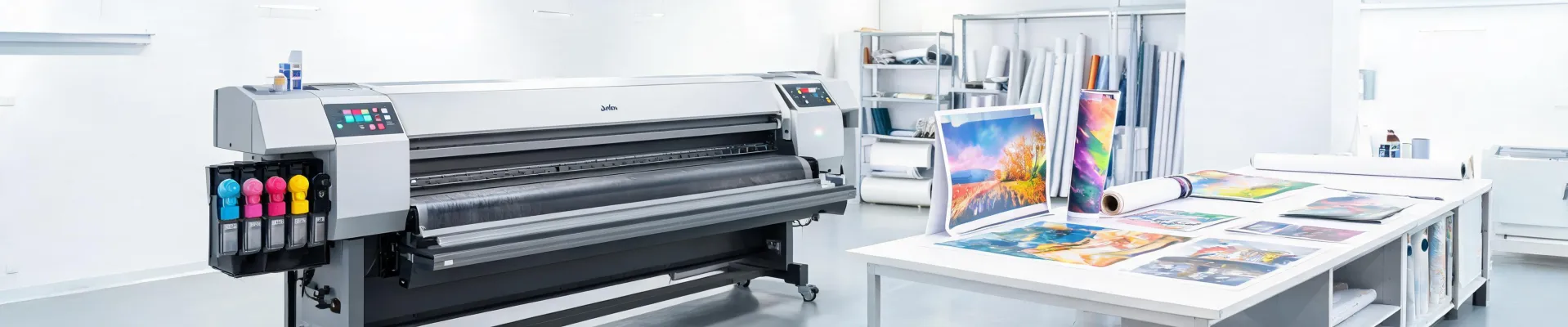
I Spent $2,300 Learning the Hard Way: Why I Finally Bought a Mutoh i1600 DTF Printer
2026-07-24 · Elise Marceau
The Day I Decided to Start DTF Printing
Back in March 2023, I was sitting in my garage looking at a pallet of blank t-shirts and thinking, “How hard can this be?” I'd been doing small-batch screen printing for a couple of years, but DTF (direct-to-film) seemed like the perfect next step—no screens, no setup fees, just print and press.
I had about $4,000 budgeted for a printer. I knew Mutoh existed—everyone in the industry talks about the ValueJet series—but the price tag on a brand-new i1600 DTF printer was way more than I was willing to spend. So I went the cheap route. I ordered a Procolored DTF printer from an online marketplace. $2,800, free shipping, looked fine in the photos. What could go wrong?
The First Batch Was a Disaster
The printer arrived in two weeks. Unboxing it was exciting—until I tried to set it up. The manual was a blurry photocopy of a translation from Chinese. The ink cartridges didn't seat properly. I spent three days on forums trying to figure out why the white ink kept clogging.
Finally got a test print. Looked okay on the film. Pressed it onto a shirt. The image came out with visible banding and the white underbase looked gray. I thought I'd done something wrong. I adjusted the heat press temperature, changed the pressure, tried different films. Nothing worked consistently.
After about 50 wasted transfers (roughly $230 in materials), I called the seller. They said, “Try cleaning the printhead.” I did—twice. Still banding. Then the printhead actually died. A replacement would cost $400 and take three weeks to ship. I was looking at a $3,200 order from a local clothing brand that needed 200 custom tees in two weeks. I was screwed.
The Trigger That Changed My Mindset
I ended up outsourcing that order to a local print shop that used a Mutoh i1600. I went to pick up the shirts and saw the machine running. The operator showed me the print quality—crisp, consistent, no banding. The white ink coverage was solid. He told me he'd run over 15,000 prints on that machine without a single printhead failure.
That moment—standing in his shop watching the Mutoh lay down perfect transfers at high speed—was the trigger. I realized I wasn't saving money by buying cheap; I was losing money in wasted materials, lost orders, and stress. I calculated the total cost of my Procolored adventure: $2,800 printer + $400 replacement printhead + $230 wasted materials + $200 in rush shipping for the outsourced order = $3,630. And I still didn't own a reliable printer.
Buying the Mutoh i1600 (and Why I Don't Regret It)
In June 2023, I bought a Mutoh i1600 DTF printer from an authorized dealer. The price was $5,200—yes, almost double what I'd spent on the Procolored. But here's what I got:
- On-site installation and training (the technician spent a full day with me)
- A proper manual in English with troubleshooting charts
- A direct line to Mutoh's tech support (answered within 30 minutes when I called)
- Reliable white ink circulation that doesn't clog
The first week I printed over 400 transfers without a single misprint. The color accuracy was so good I could match Pantone colors within Delta E of less than 2 (industry standard for brand-critical work). I didn't need to second-guess the settings—the Mutoh software had preconfigured profiles for common DTF films.
Lessons Learned (and a Check I Still Use)
Looking back, I should have just bought the Mutoh from day one. At the time, I thought I was being smart by saving $2,400 upfront. But the true cost of ownership wasn't just the printer—it was the lost revenue, the stress, and the credibility damage with my first big client.
I now keep a checklist for any new equipment purchase:
- Is the manufacturer known for industrial-grade reliability? (Mutoh: yes)
- Can I get spare parts and support within 48 hours? (Mutoh: yes, through their parts service)
- Does the dealer offer training? (Critical for DTF beginners)
- What's the expected printhead life? (Mutoh i1600 printheads typically last 12-24 months with proper maintenance)
Here's the bottom line: If you're a small shop like I was, don't fall for the “cheap alternative” trap. A Mutoh i1600 isn't the cheapest DTF printer on the market, but it's the one that will make you money instead of costing you money. And trust me on this—I've made the mistake so you don't have to.
“The cheapest equipment costs the most in the long run. I learned that the hard way. Now I only buy industrial-grade—even for small orders.”
If you're looking for a mutoh for sale, check the authorized dealers. And if you're thinking about dye sublimation printer bundles or other configurations, Mutoh has a whole lineup that works for small batches too. They don't discriminate based on order size—which is exactly what a growing business needs.

Elise Marceau
Elise Marceau is an LED display and digital-signage systems analyst covering LED video walls, modular screens, transparent LED, control processors, and indoor or outdoor signage. She applies IEC 62368-1 safety principles while comparing pixel pitch, luminance, contrast, refresh rate, colour uniformity, viewing angle, ingress protection, power density, module serviceability, and signal redundancy. Her specification guides help integrators, venue operators, retailers, and procurement teams align viewing distance, ambient light, content format, installation access, electrical load, and lifecycle support.