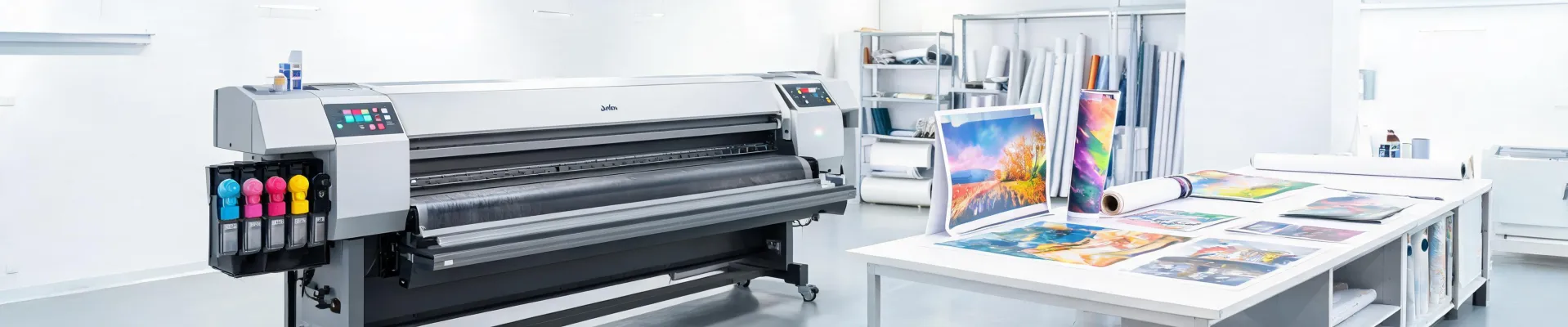
Why Your Mutoh Vinyl Printer Labels and DTF Transfers Still Look Off—and What Actually Fixes It
2026-08-14 · Elise Marceau
The Surface Problem: Your Output Looks Inconsistent
I get it. You're running labels on a Mutoh vinyl printer and the color looks different from the last batch. Or you bought a Stahls DTF printer and the transfers crack after one wash. Or your office laser & inkjet printer labels are smearing, and someone says you need a better machine.
I'm the quality and compliance manager at a commercial print equipment company. I review every output sample before it reaches customers—roughly 200 unique print runs a year. In our Q1 2024 audit, I rejected 8% of first deliveries because the color was off, the material hadn't been verified, or the label size didn't match the spec. That's not a printer problem. That's a process problem.
The Real Issue: You're Comparing Machines, Not Systems
It took me four years and roughly 800 audits to understand that most print quality problems are not machine failures. They're missing definitions. It's tempting to think a new printer is the answer. But the 'just buy a DTF 1000' advice ignores everything around the machine. A machine can be a no-brainer purchase when the current one is dead. But most quality issues won't be solved by swapping hardware.
A printer is one component in a chain: artwork, color profile, media/profile matching, ink or toner, environmental conditions, and verification. If any one of those is wrong, the output looks wrong. The machine gets blamed.
Put another way: a printer is a very obedient machine. It does what the file and profile tell it to do. If the file is wrong, the profile is wrong, or the media is wrong, the output will be wrong. The printer doesn't know the difference between a weekend test print and a 50,000-unit order.
The vendor failure in March 2023 changed how I think about equipment purchases. A customer sent us a batch of labels from a Mutoh vinyl printer that looked washed out. Their first instinct was to replace the machine. We checked the setup: the wrong ICC profile was loaded for the vinyl, and the profile's ink limit didn't match the actual ink batch. We loaded a profile for the exact media, reprinted one label, and the same printer matched the proof. The printer was fine.
Most buyers focus on the machine model and completely miss the media profile, coating, and verification. The question everyone asks is which printer should I buy? The question they should ask is how will I verify the first article? That's the part that actually controls quality.
The Media Assumption
Here's a blind spot that shows up in audits. Laser & inkjet printer labels is a generic category. It tells you the sheet can run through a toner machine and some inkjet machines. It doesn't tell you how the coating reacts with pigment ink, dye ink, or UV ink. It doesn't tell you whether the adhesive is rated for the application. It doesn't tell you whether the stock will curl.
For a Mutoh vinyl printer, the same idea applies. Vinyl is not one material. A gloss calendered vinyl might print beautifully with one profile and look like garbage with another. A label stock designed for toner may not hold pigment inkjet ink the same way. You can't assume compatibility just because the material feeds through the printer. Plus, materials have changed. What used to be a reliable generic setting can be a bad match for a newer media coating.
Color Is a Standard, Not an Opinion
Another pattern in our audits: color described in words. Make it vibrant. Make it match this sample. That's not a spec. A ballpark CMYK conversion is not a contract spec.
According to Pantone Color Matching System guidelines, industry-standard color tolerance is Delta E below 2 for brand-critical colors. Delta E of 2 to 4 is noticeable to trained observers; above 4 is visible to most people. If you don't define which color standard the label is supposed to meet, you can't measure whether the printer is doing its job.
This applies to both vinyl and DTF. You might print a DTF transfer on a Stahls DTF printer and the CMYK image looks fine. But if the garment logo includes a Pantone red, and no one has defined the expected CMYK conversion or the Delta E tolerance, you can get a red that's close but not on-brand. For a business selling branded apparel, close is a red flag.
And no, a 16-million-color printer does not make color management obsolete. It makes the starting point wider, not the target clearer.
DTF Has Its Own Hidden Variable
Direct-to-film is newer to the mainstream, but the same principle applies. A Stahls DTF printer can lay down ink perfectly. The issue often lives in the film, powder, curing temperature, or platen pressure. We've seen a DTF 1000 printer produce a clean print that still failed because the adhesive powder didn't cure evenly under the heating element. The printer itself was never the problem.
To be fair, some systems are more forgiving than others. A Stahls DTF printer is a solid system. It still won't fix a workflow with no verification step.
That's why first-article verification for DTF should include an actual transfer, on the actual garment type, with a wash test. Not just a print test.
What the 2025 Workflow Actually Requires
What was best practice in 2020 may not apply in 2025. Five years ago, DTF was a niche workflow. Now it's a standard option in shops that never owned a screen press. But the fundamentals haven't changed: a print run is only good if you can define good and measure it.
The execution has changed. Printers are more reliable. Profiles are better. Media choices are wider. But that means more variables, not fewer. A modern Mutoh vinyl printer can hit a tight color target—if you've set up the profile on the exact vinyl, controlled the room temperature, and checked the first article before running 5,000 labels. A DTF 1000 printer from Stahls can produce reliable transfers—if you treat the powder, film, and heat as part of the workflow, not accessories.
I used to blame the machine too. In 2019, I spent a full day troubleshooting a wide-format printer with banding. It turned out the file had a transparency flattening problem and the RIP was struggling. Not the printhead. I fixed the file, not the printer. That lesson stuck.
The Cost of Not Specifying Quality
Let's talk about what happens when you skip verification.
In 2022, a customer ordered 50,000 labels for a product launch. They chose a supplier based on a sample from a different material. Nobody ran a first-article check on the production stock. The labels printed, but the ink sat flat and the adhesive didn't hold at the curved edge. That quality issue cost a $22,000 redo and delayed the launch by three weeks.
The printer wasn't to blame. The spec was incomplete.
The most frustrating part is how often the same issue recurs. You'd think a written spec would prevent it, but it doesn't if no one checks the output against it. In our 2024 audit, we saw the same pattern: a printer changed, a media changed, or a file was updated, and nobody restarted the verification cycle. Each time, the cost was higher than a 15-minute first-article test.
A Short Fix: The First-Article Check
So what do you do? You don't necessarily need a new printer. You need a verification step that is not optional.
- Define the measurable spec before the run. Include substrate, ink or toner, profile version, resolution, color target like Pantone or Delta E, finish, and size tolerances. For mailpieces, include USPS shape standards if relevant. According to USPS Business Mail 101, a standard letter must be at least 3.5 inches high and 5 inches long, no more than 6.125 inches high and 11.5 inches long, and no more than 0.25 inch thick. That's the kind of external spec that catches people who design beautiful labels that don't fit the machine or the mail stream.
- Run one label or transfer first. Measure the color, check the dimensions, and test the material under real conditions. For DTF, do a wash test on the actual garment. If the first article doesn't match, don't run the batch.
- Log the variables. Media lot, ink lot, profile version, temperature, humidity, and machine settings. If the next run looks different, the log tells you which variable changed.
- Ask your supplier about coating compatibility, not just price. If you're buying laser & inkjet printer labels, ask whether the coating is designed for your printer type and production speed. If you're buying vinyl for a Mutoh printer, ask for a profile that matches the exact product, not a generic setting.
Granted, this requires a few extra minutes at the start of a run. But it saves the kind of time that turns into a late launch or a $22,000 redo.
Bottom line: a printer is rarely the hero or the villain. A Mutoh vinyl printer can deliver excellent labels if the system around it is defined. A Stahls DTF printer can produce durable transfers if the process is verified. A simple first-article check isn't sexy, but it's the difference between a launch that goes out on time and one that doesn't.

Elise Marceau
Elise Marceau is an LED display and digital-signage systems analyst covering LED video walls, modular screens, transparent LED, control processors, and indoor or outdoor signage. She applies IEC 62368-1 safety principles while comparing pixel pitch, luminance, contrast, refresh rate, colour uniformity, viewing angle, ingress protection, power density, module serviceability, and signal redundancy. Her specification guides help integrators, venue operators, retailers, and procurement teams align viewing distance, ambient light, content format, installation access, electrical load, and lifecycle support.