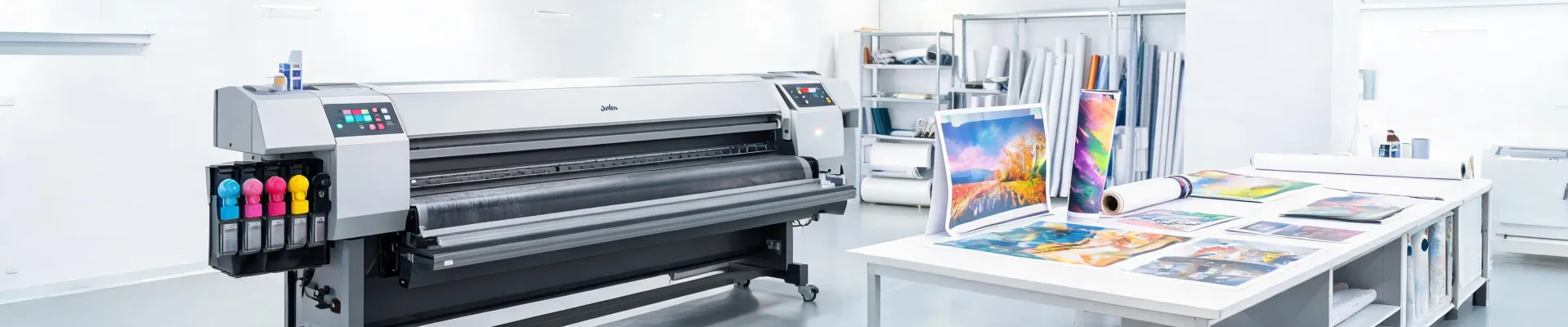
The 'Cheapest' Large Format Printer Quote Would Have Cost Us $11,000 More
2026-09-08 · Elise Marceau
In May 2024, I compared four quotes for a new UV flatbed printer. The lowest was $8,600 less than the next bid. That’s a big number when you’re a 14-person shop. But after I ran the numbers properly, the price gap didn’t just close. It reversed. The “cheap” printer would have cost us about $11,000 more over three years.
I manage procurement for a print shop in the Klang Valley, Malaysia. We make vehicle graphics, exhibition panels, ADA-compliant tactile signage, and DTF garment transfers. My job is to make sure the machines pay for themselves, so I track every invoice, service call, and reprint. Since 2019, that habit has produced a record of roughly $180,000 in cumulative printing-related spending and a clear view of where the money actually goes.
If you’re comparing quotes for a large format inkjet printer right now, here’s what I learned from that process.
The Low Quote That Almost Fooled Me
We needed a larger flatbed for rigid signage and ADA work. I called four suppliers, collected four quotes, and then spent a weekend doing what most buyers skip: I tried to figure out what each machine would cost to run, not just to buy.
The cheapest quote looked attractive for exactly one reason. The dealer couldn’t answer three basic questions: what a service visit costs after the warranty, how long spare parts take to arrive in Malaysia, and what the realistic ink cost is per square meter at production speed. Every time I asked, the conversation drifted back to the purchase price. To me, that’s a red flag.
When a salesperson can only defend the number on the invoice, that’s usually because the other numbers are worse.
The quote didn’t say any of that. It said delivery in 30 days. It didn’t mention installation, training, or what happens after the first warranty year.
I built a spreadsheet using our own consumption data from previous machines: ink coverage, head life, typical downtime, scrap rates. Then I added installation, training, spare parts, and projected service calls. The cheap machine consumed more ink per usable square meter, had a thinner local support setup, and relied on parts that weren’t stocked in this country. Over 36 months, the differences added up to far more than the $8,600 I thought I was saving.
You’re Not Buying a Printer. You’re Buying Uptime.
The service failure in March 2023 changed how I think about production equipment. Our DTF line developed a nozzle problem in the middle of a 400-shirt order. I won’t walk you through the full DTF printer troubleshooting sequence—cleaning cycles, nozzle checks, test prints, wasted film at every step. The short version: we lost four hours, three meters of transfer film, and a container of adhesive powder, and the banding came back as soon as we resumed production.
I’m not 100% sure of the final scrap number, to be honest. I remember the feeling better than the math. That order should have made us money. Instead, it taught me how much a broken printer really costs when you’re a small shop.
This is why I push back when small shops tell me they can only afford the lowest quote. I’ve been that shop. I remember being three people in a cramped unit in Shah Alam, and I remember a supplier who essentially told me to come back when we had more work. We don’t call that supplier anymore. That’s not revenge. It’s data.
A week of downtime doesn’t threaten a big corporation the way it threatens a small business. And if a supplier treats you like a nuisance before you buy, they won’t magically treat you better when something breaks.
Precision Is a Budget Line, Not a Marketing Line
When a spec sheet tells me a machine prints 1200 dpi, I nod and move on. I do not care about the number on the box. I care about how the machine prints after a hundred impressions, with the same file, same media, same conditions.
ADA signage is the best example I know. It’s a niche with decent margins, and it’s not as crowded as general wide-format work. But producing a tactile sign is not like printing a poster. You’re laying down multiple layers of ink to create raised characters and braille dots. Each layer has to land in exactly the same place as the last one. If the machine drifts by even a fraction of a millimeter, the dot becomes misshapen. A sign shop might not notice it on a demo print—but a person reading the sign by touch will.
According to the 2010 ADA Standards for Accessible Design (Section 703), tactile characters and braille have specific dimensional requirements. Verify current details with the U.S. Access Board or your local building authority, because this isn’t a cosmetic standard. It’s a legal one. A non-compliant sign means a redo. A redo means you eat the material, the machine time, and the labor.
When I hear a sign maker search for a “Mutoh ADA printer,” it’s usually not about a single model. It’s about a UV flatbed that can build multi-layer tactile characters and braille dots with repeatable precision. That’s what I’d call inkjet printer precision: placing every drop where the file says it should go, every single time. Other brands can do this too. But in my evaluation, the machines that held registration over a full production run were not necessarily the ones with the most impressive spec sheets.
What I’d Check Before Buying a Large Format Printer
If you’re in the market for a large format inkjet printer in Malaysia—or anywhere else, honestly—use the checklist I wish I’d had years ago:
- Cost per usable square meter, not price per liter. Ask how many passes and how much ink the machine actually needs to hold consistent quality. That number decides your month-end profit.
- Parts and service depth, not just the warranty period. Ask how many spare parts are stocked locally. In Malaysia, a machine with a three-week wait for a printhead isn’t production equipment.
- Precision under real conditions. Bring your own test file with fine text and layered structures. Print it, measure it, and run the job again. Don’t judge from a glossy demo print.
- Installation, training, and the rest of the quote. A low price that excludes installation and operator training is not a low price.
- How the seller treats small buyers. Ask how they handle a first-time customer. Their answer tells you exactly what will happen when you need help later.
That checklist is why we signed a purchase order for a Mutoh UV flatbed printer even though it was $8,600 more than the cheapest quote. The Mutoh dealer we worked with in Malaysia answered my questions in writing, stocked common spares locally, and let me run a test file from our own shop. The machine held registration well enough for ADA work, and the ink consumption numbers matched the vendor’s claims.
I still second-guessed after signing. What if I had missed a hidden cost? What if the repair assumptions in my spreadsheet were too optimistic? I didn’t fully relax until the first few months of invoices arrived. Total service spending on that flatbed so far? A little under $200 for routine parts. I’ll take that.
That doesn’t mean the machine will never need maintenance. It will. But maintenance is now a number in my budget, not a crisis.
I can’t tell you which printer is right for your shop. Your volumes aren’t my volumes, and your customers aren’t mine. But I can tell you this: the purchase price is the easiest number to compare and the least reliable one to trust. Run your own model before you commit. If a machine’s numbers survive your spreadsheet, it’ll probably survive your production floor.

Elise Marceau
Elise Marceau is an LED display and digital-signage systems analyst covering LED video walls, modular screens, transparent LED, control processors, and indoor or outdoor signage. She applies IEC 62368-1 safety principles while comparing pixel pitch, luminance, contrast, refresh rate, colour uniformity, viewing angle, ingress protection, power density, module serviceability, and signal redundancy. Her specification guides help integrators, venue operators, retailers, and procurement teams align viewing distance, ambient light, content format, installation access, electrical load, and lifecycle support.