Small Rush Orders Aren't Favors. They're the Best Marketing a Print Shop Will Ever Get.
2026-09-03 · Elise Marceau
Here's an opinion that gets me into arguments at trade shows:
Small rush orders aren't favors. They're the best customer acquisition most print shops will ever get, and they get dismissed because the invoice is small and the deadline is uncomfortable.
I coordinate production at a sign, display, and garment decorating shop in Virginia. In eight years of triaging emergency printing work, I've pushed more than 200 jobs across the finish line where the deadline was measured in hours, not business days. They've ranged from a $190 replacement sign for a church to a $15,000 trade show exhibit that had to be reprinted after a freight company dropped a crate in the wrong city.
I didn't always feel this way. When I started, I treated small urgent orders like jury duty: unavoidable, unpaid in attention, and something to get through. The math changed my mind. Last quarter alone—Q4 2024—we scheduled 47 expedited jobs and got 45 of them out the door on time. The median ticket on those jobs was roughly $640. Most of those clients sent us something bigger within six months.
The 36-Hour Job That Ended My Eye-Rolling
In March 2024, at 4:10 p.m. on a Tuesday, a property manager called about five ADA signs. A building inspection was scheduled for 10 a.m. Thursday. The general contractor had been quoted a seven-business-day turnaround by an ADA sign vendor and refused to rush it; another vendor wouldn't touch the order because it fell below their $1,000 minimum. Our quote was $610.
This is where the search term “Mutoh ADA printer” tends to show up in our analytics. People don't type that because Mutoh sells a product literally named that. They type it because they're in a situation like the one I just described and they're trying to understand the workflow: can a UV flatbed printer make compliant ADA signs fast enough to save a deadline?
The honest answer is yes, with caveats. A UV flatbed printer prints onto rigid materials like acrylic and aluminum composite, cures the ink instantly, and can build up layers of clear ink to create tactile characters. That's what makes same-day sign fabrication possible. But I won't tell you to trust direct-printed braille or assume every raised-letter profile passes inspection. At our shop, we use a separate braille application process, and we measure everything with calipers against the current ADA Standards—2010 edition, Section 703, available at ada.gov; verify the current text before relying on it. I learned that lesson the hard way.
In my first year doing this job, I made the classic rookie specification error: I approved a proof without checking the raised character height properly. The inspector checked it for me, with calipers, and we redid two signs at our own cost. A $760 mistake, completely mine. The lesson wasn't “don't rush.” The lesson was that code compliance doesn't care how urgent the job is.
That March 2024 order, though, went out clean. Five signs printed, finished, and delivered to the client's site by 6:10 p.m. Wednesday. The inspection passed without comment. That property manager has since sent us nearly $9,000 in additional work—room signage, directory boards, cafe menu boards—all because a $610 emergency was treated as if it were a $61,000 account. Small orders are not a side quest. They're the front door.
What “UV Printer Meaning” Questions Actually Get Right
If you've ever typed “uv printer meaning” into a search box at 7 p.m. because a customer asked you a question you didn't want to admit you couldn't answer, this one's for you.
A UV printer is exactly what it sounds like: a printer that uses UV-curable liquid inks and cures them with ultraviolet light almost instantly after they're laid down. There's no evaporation time and no heat soaking into the substrate. That matters more than most people realize. Because curing is instant, the printed piece can be handled, stacked, layered, cut, or laminated right away. And because there isn't a dryer blasting hot air, you can print onto rigid materials—acrylic, PVC board, aluminum composite—without warping them.
Why does that matter for small rush orders? Because small urgent jobs are often small urgent rigid jobs. A one-off acrylic panel. A short run of tactile signs. A prototype for a product launch. A roll-to-roll solvent printer can't do those. A UV flatbed can.
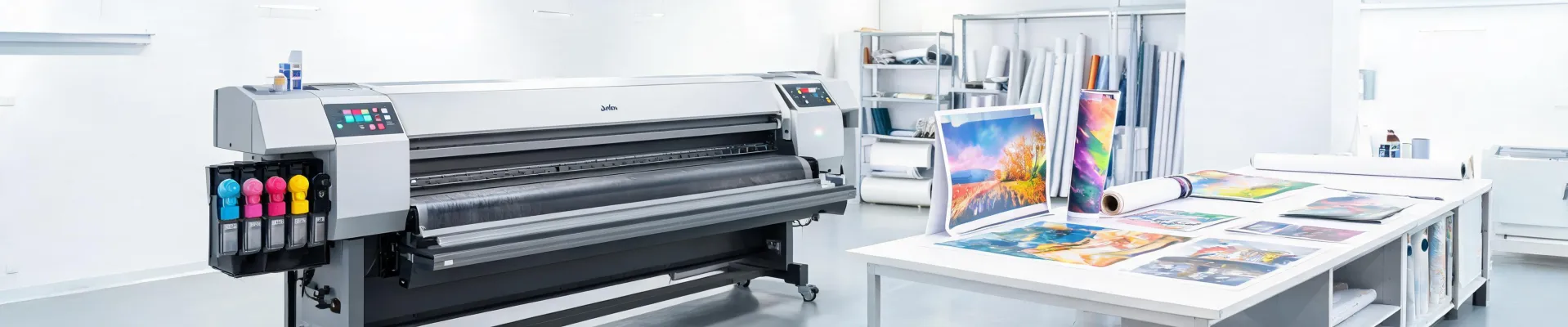
The flatbed we keep in the middle bay is a Mutoh flatbed printer. In our shop, it's earned the nickname “the ADA printer,” but it's really the “print it on anything you can strap to the table” printer. Clipboard, polycarbonate sign blank, 0.5-inch thick aluminum composite scrap someone found in a dumpster—if it sits reasonably level, we can likely print on it. That flexibility is exactly what makes weird small jobs profitable instead of annoying.
The Best “DTF Printer Hack” I Know Is Boring
The garment side of our shop has its own version of this story. Last November, a local fitness studio ordered 30 hoodies for a charity 5K. Pickup was scheduled for 7 a.m. two days later. At 9 p.m. on the first night, our lead operator ran a test strip and found horizontal banding through the white underbase on our DTF line.
If you search “dtf printer hack” at that moment, you'll get a thousand suggestions: crank the ink limits, override the profile, flood the printhead, buy some additive that promises to fix everything. What actually fixed ours was deeply unglamorous. We ran a nozzle check, cleaned the encoder strip, and realized the film roll had been sitting near a cold exterior door all day. We moved the film into a conditioned cabinet, waited twenty minutes, and reprinted the test. Clean. No profile hacks, no magic ink.
The DTF printer hack that saves you on a deadline is boring: control your environment, keep your heads clean, and verify before you commit to a full run. I've never seen a YouTube shortcut save someone at 11 p.m. I've seen a checklist save a lot of people.
An Authorized Dealer Is the Other Half of the Machine
None of this works if the machine is down. And this is the part that separates shops that can say yes to rush work from shops that have to apologize.
In June 2023, a damper on our flatbed started misbehaving on a Friday afternoon. It's a small part—maybe $200 worth of hardware—but without it, the whole printer is a very expensive paperweight and our Monday deadline becomes a problem. A marketplace listing for a non-genuine part was about $90 cheaper and promised delivery in ten to twelve days. Our Mutoh authorized dealer had the genuine part on the shelf and a technician within driving distance. The printer was printing again Monday morning.
That experience shaped how I advise people buying any industrial printing equipment. For example, I have a friend who runs a small packaging operation. When he was shopping for a coding system, he told me he was searching for an “authorized dealer of continuous inkjet printer” rather than just hunting for the lowest price. I told him he was doing it exactly right. Continuous inkjet technology—CIJ—is a different world from the piezo drop-on-demand printers we run; it's often used for date codes and lot numbers on packaging lines. But the reliability logic is identical. The machine is only as good as the people who are allowed to fix it.
An authorized dealer isn't a luxury add-on. It's uptime. And uptime is what lets you take small rush orders without gambling your whole week.
Now Argue With Me
I can already hear the objection: “A $600 order doesn't pay the electric bill.” Fair. One $600 order doesn't. But the machine is either running or it isn't, and an urgent small job scheduled into otherwise idle time at a fair rush fee covers labor while building the habit of decisiveness. The $14,000 order with a four-week lead time is usually the one that gets shopped around by three brokers and delayed by six change requests. The $600 deadline job is usually decided in one phone call.
Another objection: “If you say yes to every panic, your floor belongs to the calendar.” That's true only if you treat every rush as an emergency to absorb rather than a product to price. A rush fee isn't discrimination against small customers. It's honesty about capacity. Small customers don't need charity; they need a vendor who answers the phone and delivers what was promised.
So here's my position, restated clearly: if a shop can't serve a small rush order, the problem isn't the customer's order size. It's the shop's setup, its equipment, or its attitude. In a printing market where most work gets commoditized by online ordering platforms, the small urgent job is one of the last places where actual human service still wins.
Take the small order seriously. Take the deadline seriously. And when that customer grows into a bigger account, don't act surprised. You earned it the day you didn't roll your eyes at their $610 problem.

Elise Marceau
Elise Marceau is an LED display and digital-signage systems analyst covering LED video walls, modular screens, transparent LED, control processors, and indoor or outdoor signage. She applies IEC 62368-1 safety principles while comparing pixel pitch, luminance, contrast, refresh rate, colour uniformity, viewing angle, ingress protection, power density, module serviceability, and signal redundancy. Her specification guides help integrators, venue operators, retailers, and procurement teams align viewing distance, ambient light, content format, installation access, electrical load, and lifecycle support.