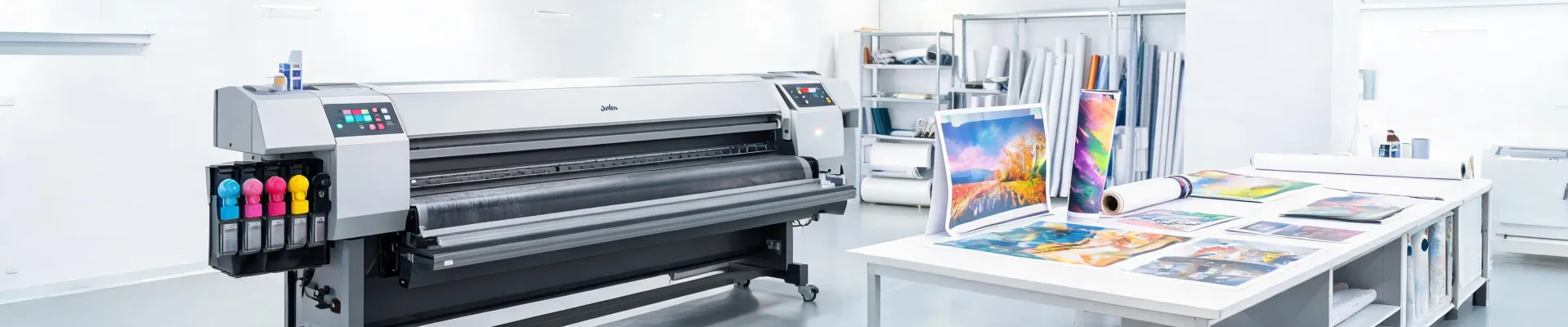
Small Orders, Real Standards: What I Check Before Approving a Mutoh Eco-Solvent Printer, DTF, or UV Setup
2026-09-28 · Meera Kulkarni
-
Small orders deserve the same scrutiny
-
Argument 1: A small shop cannot absorb a vague spec
-
Argument 2: Power specs are not fine print
-
Argument 3: Small orders are your QA lab
-
The expected pushback: small orders cost more to serve
-
Why this matters for Mutoh buyers
-
What I check before I sign
-
Reaffirming the point
Small orders deserve the same scrutiny
If a supplier treats your first $500 order like a nuisance, I wouldn't trust them with your $20,000 order. Small orders deserve the same spec discipline, honest lead times, and straight answers as large ones. That sounds soft. It isn't. It's a quality-control position.
I'm a quality and brand compliance manager at a commercial print services company. I review every equipment purchase and print spec before it reaches customers—roughly 200+ items annually. In 2024, I rejected about 12% of first deliveries due to off-spec color, damaged parts, wrong power specs, or documentation that didn't match the quote. Over four years of reviewing deliverables, I've learned that the size of the invoice rarely predicts the size of the problem. When I implemented our verification protocol in 2022, I added three rules: no verbal specs, no sample-free approvals, and no power assumptions.
Everything I'd read about equipment buying said small shops should accept entry-level answers. In practice, the small shops that asked for full power and color data got fewer surprises. The ones that didn't spent their savings on downtime.
Argument 1: A small shop cannot absorb a vague spec
When you're a two-person shop, a wrong damper or a mislabeled ink set isn't an inconvenience. It's a week of lost production. I saw this in our Q1 2024 quality audit. We received a batch of 120 dampers where the inlet diameter was visibly off—about 0.3 mm against our 0.05 mm tolerance. The vendor claimed it was within industry standard. We rejected the batch, and they redid it at their cost. Now every contract includes dimensional and ink-compatibility requirements in writing. That kind of paperwork feels excessive until it saves you a $22,000 redo and a delayed launch.
That same standard applies to a Mutoh eco solvent printer. Don't just ask for max print speed. Ask for color consistency over a 50-piece run, standby power draw, daily maintenance time, and the real cost of a printhead replacement. If you're adding a Mutoh printer cutter, test registration on 10 decals before you trust it on 10,000. For a sublimation printer set, ask for ICC profiles and ink batch consistency, not just the claim that it works with polyester. And if you're considering the smallest DTF printer on the market, ask about waste ink, maintenance cycles, and whether the compact footprint comes with a compact warranty.
Argument 2: Power specs are not fine print
I almost skipped a pre-purchase power audit to save $300. So glad I didn't. The quote listed a Focus Alpha-Jet Plus UV printer power consumption number that looked fine in the brochure, but it was peak draw, not typical. We were one circuit away from a 30-amp upgrade after installation. Dodged a bullet when the electrician asked for the nameplate and duty cycle.
Here's what I ask now for any UV or DTF unit: peak watts, typical watts, standby watts, and whether curing lamps cycle. Then I do the math. A unit drawing 1,200 W peak and 400 W typical for 6 production hours at $0.16/kWh is roughly $0.38 per day in typical mode—before HVAC. If a vendor only gives one number, treat it as marketing, not a spec. For a small shop, a wrong power assumption can mean a new circuit, a noisy generator, or a printer that can't run at rated speed.
Argument 3: Small orders are your QA lab
Never expected the smallest DTF printer to be the hardest to spec. Turns out compact units often have higher relative waste ink and longer maintenance cycles. A 10-piece trial run revealed more about a vendor than a 10,000-piece promise. Did they send the right ICC profile? Did the ink batch match? Did the cutter hold registration after 20 minutes?
I ran a blind test with our team in 2023: the same decal file printed through two calibrated setups. One setup used a properly maintained Mutoh eco solvent printer with fresh profiles; the other used a close-enough profile. Sixty-eight percent identified the profiled output as more professional without knowing which was which. The cost difference was about $0.32 per piece. On a 5,000-piece run, that's $1,600 for measurably better perception. That's not vanity. That's brand compliance.
The expected pushback: small orders cost more to serve
I'm not saying small orders should get volume pricing. Setup costs are real. A vendor who says our minimum is 100 pieces earns respect. A vendor who says we'll do 10 but can't guarantee color is telling you something important. The problem isn't minimums. The problem is pretending there are no minimums, then delivering B-grade work.
Small doesn't mean unimportant—it means potential. When I was starting out, the vendors who treated my $200 orders seriously are the ones I still use for $20,000 orders. That's not sentiment. That's procurement strategy. If you're buying a Mutoh printer cutter for a weekend sign business, you should still get a clear answer about blade life and registration tolerance.
Why this matters for Mutoh buyers
Mutoh equipment often lands in shops that are growing from one press to three. That growth stage is exactly when bad assumptions hurt most. A Mutoh eco solvent printer may be the first machine that runs all day. A Mutoh printer cutter may be the first cutter that has to hold registration after lamination. A sublimation printer set may be the first step into apparel. The smallest DTF printer may be the first compact unit that has to pay for itself in six months. None of those transitions are small to the owner. So I don't treat them as small in the approval process.
What I check before I sign
- Color: For brand-critical colors, I ask for Delta E data. Industry standard tolerance is Delta E < 2 for brand-critical colors. Delta E of 2-4 is noticeable to trained observers; above 4 is visible to most people. Reference: Pantone Color Matching System guidelines.
- Resolution: Commercial offset printing needs 300 DPI at final size. Large format viewed from distance may accept 150 DPI. Newsprint is 170-200 DPI. These are minimums, not targets.
- Parts: For a Mutoh printer cutter or eco-solvent unit, I want part numbers, lead times, and warranty terms in writing.
- Power: For a Focus Alpha-Jet Plus UV printer power consumption review, I want peak and typical draw, plus circuit requirements.
- Consumables: For a sublimation printer set or smallest DTF printer, I ask about ink lot consistency, waste ink rates, and cleaning cycles.
Reaffirming the point
If you're a small print shop, a garment decorator, or a sign maker buying your first Mutoh eco solvent printer, don't let anyone tell you that detailed specs are for big accounts. Ask the same questions a 50,000-unit annual account would ask. Ask about power. Ask about color. Ask about parts. Ask for a small trial. The vendors who answer clearly are the ones worth keeping.
Small orders aren't a nuisance. They're where quality culture either starts or dies. I'd rather approve a careful 10-piece order than clean up a careless 10,000-piece disaster.
Meera Kulkarni
Meera Kulkarni is a textile-printing equipment analyst covering DTF, DTG, dye-sublimation, and eco-solvent printers with their pretreatment, powdering, curing, pressing, and finishing workflows. She uses ISO 105-C06 laundering tests for applicable printed textiles while tracking colour difference, ink laydown, transfer temperature, dwell time, curing profile, washfastness, nozzle reliability, media tension, and production yield. Her process guides help decorators, apparel producers, and print shops select equipment, inks, films, fabrics, and operating windows for repeatable output.