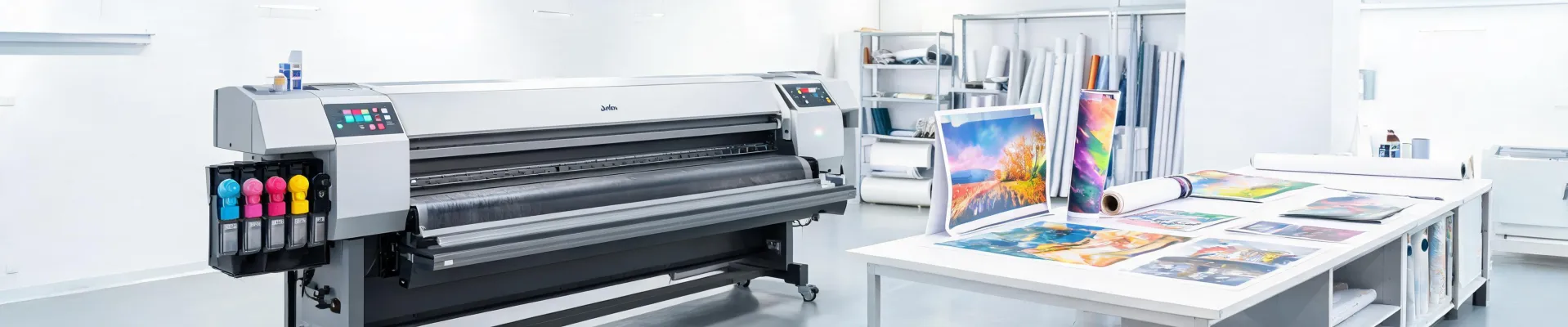
Mutoh UV Printer vs. DTF vs. Sublimation: What a Procurement Buyer Checks Before Signing
2026-08-04 · Elise Marceau
-
The three scenarios I run into most
-
Scenario A: You want a Mutoh UV printer for rigid signage
-
Scenario B: You're printing fabric and thinking about dye-sublimation
-
Scenario C: You're adding DTF and wondering if the UV printer can cover it
-
One habit that covers all three scenarios
-
How to know which scenario you're in
Here's the short version: there's no single best Mutoh printer. There's the one that fits your workflow, your substrate mix, and your ability to handle downtime. I've been the administrative buyer for a 40-person print production company since 2021. I manage about 60-80 purchase orders a year, maybe $800,000 in annual spend across eight to ten vendors, and I report to both operations and finance. I should add that I'm a buyer, not a technician. My job is to make sure a new machine doesn't turn into an unplanned expense later.
That's why Mutoh support and the inkjet printer warranty matter more to me than the brochure specs. Here's what you need to know before you choose a Mutoh UV printer, a dye-sublimation setup, or a dedicated DTF line.
The three scenarios I run into most
In my experience, buyers fit into three broad categories. If you can figure out which one you're in, the decision gets a lot easier.
- Scenario A: a sign or display shop buying a Mutoh UV printer for rigid boards and roll-to-roll work.
- Scenario B: a fabric printer evaluating dye-sublimation for polyester materials.
- Scenario C: a garment decorator adding DTF transfers.
Some shops are in more than one category. That's okay. But don't decide until you know where the actual revenue comes from.
Scenario A: You want a Mutoh UV printer for rigid signage
For rigid signage, the Mutoh UV printer line is worth a serious look. I choose based on daily productive output, not the maximum speed in the spec sheet. Here's something vendors won't tell you: maximum speed is often measured at one pass, low quality, and small data. Real production speed is usually 50-60% of that number. The machine that keeps your floor moving is the one that can run all day, not the one with the biggest number. I want to say most shops lose at least a few shifts per year to avoidable downtime, but don't quote me on that exact number.
The counterintuitive part is that I'd rather buy a slightly slower Mutoh UV printer from a dealer with a technician two hours away than a faster machine from a manufacturer whose closest support person is a flight away. Downtime is the real price of a printer. (Should mention: you only learn this after you ask for a list of authorized service partners.)
Before you sign, read the inkjet printer warranty carefully. In the U.S., the Magnuson-Moss Warranty Act (15 U.S.C. § 2301) protects you from warranty tie-ins. A manufacturer can't force you to use only its branded ink or parts just by writing it into the warranty, unless they provide those items for free or get an FTC waiver. They can still deny a claim if they show the third-party item caused the damage. The burden is on them. I'm not a lawyer, but I've heard sales reps imply the opposite. Get the written policy before you choose a supplier.
That's where Mutoh support matters. Ask for response times in writing, ask where replacement dampers and printheads are stocked, and ask how many authorized technicians are in your region. A dealer who can take your call and get you a part in two days is worth way more than a $2,000 discount.
Scenario B: You're printing fabric and thinking about dye-sublimation
If your work is mostly polyester, dye-sublimation can give you brighter colors and a softer hand feel than UV direct printing on fabric. But it's not just a different ink set. The workflow includes transfer paper, a heat press, and a way to manage lengths of fabric. That's a bigger jump than most buyers expect.
Before you commit, ask to see the vendor's sublimation printer library. A useful library will have ICC profiles, substrate guides, cleaning procedures, and file templates for common transfer sizes. If the library is thin, plan to build those profiles yourself. I've seen that eat a quarter of a production month. The dye-sub machines I trust are the ones with a deep knowledge base behind them.
For a Mutoh UV printer user, dye-sublimation is a separate decision, not an add-on. Mutoh support can help with the printer side, but the heat press and transfer paper are outside that scope. I'd budget for a full training day and at least one test roll before you call it a product line. If more than half of your work is polyester fabric, it may be the right call. If your revenue is still mostly rigid boards, don't force it.
Scenario C: You're adding DTF and wondering if the UV printer can cover it
DTF is the breakout print workflow in garment decorating right now. I understand why: you can print full-color transfers on film and press them onto many fabrics without pre-treatment. The question I hear a lot is whether a UV printer can handle it. My answer: a UV printer is not a substitute for a dedicated DTF line.
DTF transfers need a machine designed for transfer film, powder curing, and the shaking process. If you're comparing a dedicated unit like the Ink Sonic DTF printer with a UV printer, you'll see the difference in the film handling, the curing section, and the ink system. Those differences decide your cycle time. Printhead speed doesn't matter if the machine can't move the film through the powder line at the same pace.
What most people don't realize is that DTF is a workflow, not just a printer. You're adding film, powder, heat, and a lot of small batch quality checks. The machine quote is only part of the total cost. I made this mistake on a smaller purchase a few years ago: saved $180 on a maintenance kit from a no-name distributor, then paid $900 for a service call and lost a day and a half of production. That's the kind of false economy that shows up in every support scenario.
One habit that covers all three scenarios
Keep a maintenance log for every printer, whether it's UV, dye-sub, or DTF. We didn't have a formal log for a machine we bought in 2022. A printhead issue came up, and the distributor asked for service records. We had notes, but not the daily log they wanted. That conversation went nowhere. Now I use a one-page tracker and fill it out after every nozzle check. It sounds boring, but it saves real money if you ever need to make a warranty claim.
How to know which scenario you're in
If more than 70% of your jobs are rigid material, start with Scenario A. If more than half of your yardage is polyester fabric and you already have a heat press, start with Scenario B. If you're a garment decorator and the demand is for full-color transfers across many sizes, start with Scenario C.
If you're really in two scenarios, don't buy two machines yet. Track utilization for 90 days before you spend another budget cycle on a second printer. The second machine should prove it earns floor space. The counterintuitive part is that a machine that looks versatile at first often ends up as a compromise that does neither workflow well.
After five years of purchase orders, here's where I land: the best printer isn't the one with the best demo. It's the one with the best support and warranty setup. A Mutoh UV printer can be the right choice for rigid and mixed roll-to-roll work. For dye-sublimation, look for a machine with a solid sublimation printer library. For DTF, give the Ink Sonic DTF printer a fair comparison. And whatever you choose, read the inkjet printer warranty before you allocate the budget. The quote is not the cost. Trust me on this one.

Elise Marceau
Elise Marceau is an LED display and digital-signage systems analyst covering LED video walls, modular screens, transparent LED, control processors, and indoor or outdoor signage. She applies IEC 62368-1 safety principles while comparing pixel pitch, luminance, contrast, refresh rate, colour uniformity, viewing angle, ingress protection, power density, module serviceability, and signal redundancy. Her specification guides help integrators, venue operators, retailers, and procurement teams align viewing distance, ambient light, content format, installation access, electrical load, and lifecycle support.