Mutoh for Sale: A Cost Controller's Guide to Mutoh Vinyl Printers, Inkjet Encoders, and Sublimation
2026-08-03 · Elise Marceau
If you're searching "Mutoh for sale," here's the conclusion up front: The purchase price is not the cost of the machine. Over the first three years, a used Mutoh vinyl printer can cost you 1.5 to 2x the sticker price in printheads, encoder strips, ink waste, and downtime. The question isn't "What's the best deal?" It's "What will this machine cost me per usable square foot?"
I'm a procurement manager at a 42-person sign and garment production shop. I've managed roughly $1.1 million in equipment and maintenance spend over the past seven years. We run two Mutoh ValueJet eco-solvent printers and one dedicated sublimation printer. I've also replaced enough inkjet printer encoders to know exactly what they cost.
Mutoh for Sale: The Math Starts After the Purchase
From the outside, buying a used Mutoh looks simple: the machine is listed, the price is attractive, the photos are clean. The reality is that used wide-format printers are more like used commercial trucks than used laptops. The last owner's maintenance habits determine your first-year expenses. I once asked a seller if a machine was in "good condition." They meant the lights come on. I meant it could hold registration on a test print. We found out when the output showed banding in every one of the four colors.
Look, I'm not saying all used Mutoh printers are bad. Some are great. The ones that are great have one thing in common: documented maintenance. They have print logs, service records, and an owner who can tell you when the encoder strip was last cleaned or replaced.
The next time you see a Mutoh for sale that's priced way below market, ask why. Then ask what the last four service invoices show. If the seller can't show them, budget as if you're buying a printhead next month.
What a "Mutoh Vinyl Printer" Actually Is
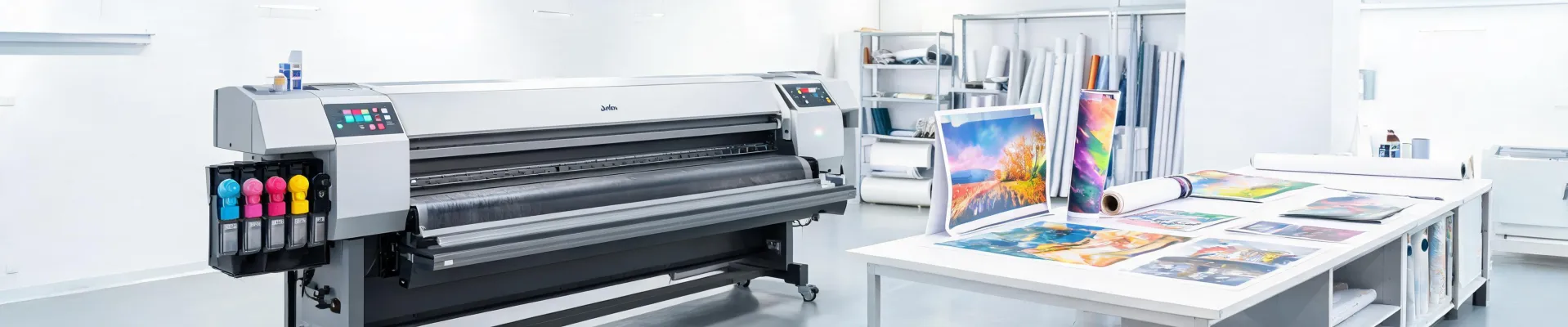
When people search "Mutoh vinyl printer," they're usually looking at a roll-fed eco-solvent printer that prints images on adhesive vinyl, banner vinyl, mesh, and film. The word "vinyl" describes the media, not something the printer makes. That distinction matters because your buying decision depends on whether you're printing outdoor signage, vehicle wraps, or garment graphics.
A Mutoh ValueJet is not a desktop inkjet. It's an industrial tool. It needs proper ventilation, regular maintenance, and a person on staff who understands CMYK plus light colors. If you're used to a $300 desktop printer, the maintenance rhythm is a different world.
Inkjet Printer Encoders: The $76 Part That Stops a $40,000 Printer
Here's the part almost nobody asks about: inkjet printer encoders. These thin strips or disks tell the printhead carriage exactly where it is. When they get dusty, greasy, or worn, your printer starts printing with banding or shifted layers. The part itself can cost anywhere from $50 to $120. The labor call can cost $200.
In March 2025, a genuine Mutoh encoder strip cost us $76. The service call was $190. Total: $266 to fix a banding problem that the shop had been ignoring for two weeks. Before that, we'd blamed the profile, the ink, and the operator. The fix was a strip of plastic with fine lines on it.
That's the counterintuitive part: the most expensive failure on a wide-format printer is often not the $1,200 printhead. It's the $76 part you've never heard of, working badly enough to make you think the entire machine is dying.
Sublimation Printer: What Can You Make?
If you're evaluating a sublimation printer, the same TCO logic applies. A starting answer to "sublimation printer what can you make" is: custom sportswear, polyester shirts, mouse pads, mugs, aluminum photo panels, ceramic tiles, flags, banners, tote bags, and any polyester-coated blank. The key word is polyester or poly-coated. Pure cotton won't hold a dye-sub image. We learned that the hard way with a batch of company shirts.
The best part of getting sublimation right: the colors don't sit on top of the substrate. They absorb into it. There's something satisfying about a clean transfer on a metal panel, especially after the setup stress. But it's a different workflow from an eco-solvent Mutoh. You need sublimation ink, a dedicated printhead or printer, and a heat press.
Now, about "xtool sublimation printer." I see that search a lot. Xtool is a laser engraver company. They don't make a dedicated sublimation printer. If you came here hoping to buy one, you're probably looking for a complete dye-sub station: a printer that uses sublimation ink and a heat press. Don't buy a laser machine instead and expect it to do dye-sub prints. A laser can engrave and mark, but it can't print a full-color photographic image the way a sublimation printer can.
Where does Mutoh fit in all this? In my shop, the Mutoh eco-solvent machines handle signage and wraps, and the sublimation station handles the garment and promo side. They're separate jobs. If you only have money for one machine, ask which output pays your rent. If it's signs, get a used Mutoh with clean logs. If it's mugs and shirts, put your money into a dedicated sublimation system.
My Mutoh Purchase Checklist
After tracking 7 years of invoices, here's what I'd verify before handing over money for a Mutoh for sale:
- Ask when the inkjet printer encoders were last cleaned or replaced. If the seller can't answer, budget for new ones.
- Print a nozzle check and a banding test yourself. Don't rely on a screenshot.
- Ask for printhead replacement history. A head with 1,000 hours is different from one with 5,000.
- Add $2,000 to $3,500 for parts and service in year one. That's based on our invoices, not a marketing estimate.
- Confirm the machine can run the media you actually sell. A "vinyl printer" isn't automatically right for window perf or high-tack films.
When a Mutoh Is the Wrong Choice
Let me be honest about the boundaries. If you're a one-person shop just starting out and you're staring at a cheap Mutoh for sale, pass. A heavy used machine needs a stable floor, ventilation, compressed air, and a local service person who isn't a random tech. If you only print occasional vinyl decals, a small desktop cutter/plotter might be enough.
If your goal is mugs and t-shirts, don't buy an industrial Mutoh. Buy a dedicated sublimation printer. And if you're a hobbyist who typed "xtool sublimation printer" in the search bar, start with a hobby-level dye-sub system, not a commercial wide-format machine.
Here's the industry evolution part: the fundamentals haven't changed—media, ink, heat, and physical mechanics still decide how good a print looks. But the economics did change after 2020. Used machines that used to make sense now need parts that may take weeks to ship. What was best practice in 2020 may not apply in 2025. That's why I run every purchase through a total cost of ownership spreadsheet, not a gut feeling.
Bottom line? A Mutoh can be an incredibly cost-effective workhorse if you buy it with your eyes open. The purchase price is just the entry ticket. The real cost is in maintenance history, encoder health, and downtime—the stuff no listing will tell you.

Elise Marceau
Elise Marceau is an LED display and digital-signage systems analyst covering LED video walls, modular screens, transparent LED, control processors, and indoor or outdoor signage. She applies IEC 62368-1 safety principles while comparing pixel pitch, luminance, contrast, refresh rate, colour uniformity, viewing angle, ingress protection, power density, module serviceability, and signal redundancy. Her specification guides help integrators, venue operators, retailers, and procurement teams align viewing distance, ambient light, content format, installation access, electrical load, and lifecycle support.