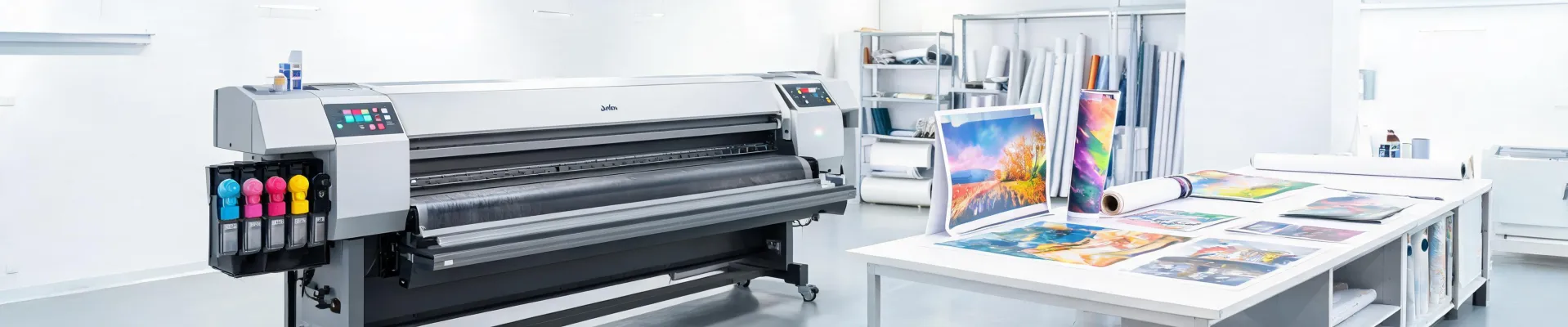
DTF Printer Specifications: What I Learned After Spending $14,000 on the Wrong Machine
2026-08-07 · Elise Marceau
In early 2023, I bought a Brother MFC-J1010DW inkjet all-in-one printer to try DTF transfers. Yes, that Brother. The office printer. I'd watched videos of people "converting" them for DTF. What those videos don't show you is the ink clogs, the film that won't adhere, the powder that fuses wrong, and roughly $600 in wasted material before I gave up. (Should mention: I'm not saying it never works. I'm saying it's a hobby project, not a production line.)
But the real damage happened a year later. I spent $14,000 on a production-grade DTF printer—and made the same mistake I did with the Brother. I trusted the spec sheet.
That's what I want to talk about today. Not the basics of DTF printing. Plenty of guides cover those already. I want to talk about the gap between what a specification document tells you and what a printer actually does on your shop floor after three weeks of production. Because that gap is where the money goes to die.
The Surface Problem: DTF Printer Specs Look Convincing
When I was shopping, I made a spreadsheet. Resolution, speed, ink type, head configuration, price. I compared Mutoh's DTF lineup against two imports and a converted eco-solvent machine. I studied color gamut charts. I read printhead specs. I felt prepared.
Here's what I missed: I was comparing marketing documents, not production machines.
That spreadsheet didn't tell me what happens at hour 700 of operation. It didn't tell me what white ink looks like after sitting overnight. It didn't tell me how many times the auto-clean cycle burns ink between prints. The spec sheet said "maximum print speed: 108 square feet per hour." I read that as "this is how fast I'll print." Those are two very different numbers.
The Deeper Problem: Specifications Measure Capability, Not Consistency
Let me break down what I actually learned—the expensive way—about reading DTF printer specifications.
1. DPI figures are near-meaningless when comparing different printers
Two machines can both claim 1200 DPI. One uses a fixed-dot head with minimal passes to hit that number. The other uses variable-dot technology with more passes and controlled ink layering. Same spec on paper. Radically different output on a dark shirt. The first one looks grainy. The second one (thankfully) looks clean.
Search for "724 DTF printer specifications" and you'll see what I mean. Page after page of similar-looking tables, same headline numbers. But the machines behind those numbers are nothing alike.
2. Speed claims are theoretical maximums
That 108 sq ft/hr rating? It assumes minimum passes, a perfectly climate-controlled room, fresh ink, and zero interruptions. In real production—with quality settings that avoid banding, with reel changes, with the occasional clean-carry cycle—you'll see maybe 50-60 percent of that number. I've timed it. On both my old machine and the Mutoh I run now.
As a reference point, commercial print standards recommend 300 DPI at final size for most applications (according to standard print resolution guidelines). But the far more important spec is the one that doesn't appear anywhere: consistent output at your target quality level, over time.
3. "ADA printer" specs don't capture what actually matters
People search for "Mutoh ADA printer" because Mutoh's UV flatbeds can produce tactile signage by building up layers of UV-cured ink. It's a genuinely useful application—braille dots and raised lettering without photopolymer materials. But here's the catch: no spec sheet tells you how many passes it takes to build a braille dot tall enough to be ADA-compliant. That information lives in production testing, not in the marketing PDF.
I learned this when I quoted a $3,200 ADA signage order based on my printer's maximum speed. The reality: building braille dots to ADA height (approximately 0.023 to 0.035 inches) requires repeated layered printing with curing passes between each layer. My quote assumed a 4-hour production run. The actual run took close to 12 hours. That's an entire profit margin gone because I trusted a specification instead of running a test.
The spec sheet isn't wrong. It's just incomplete. It describes what the machine is capable of under ideal conditions. Your shop is not an ideal condition, and your deadlines can't wait for one.
The Cost: What the Spec Sheet Didn't Tell Me
Let me put hard numbers on this. In the first six months with that "budget" DTF machine, the hidden costs were:
- Ink waste: About 40 percent higher consumption than the spec sheet suggested. White ink settling, purge cycles, head cleaning. Around $1,800 in unplanned cost.
- Failed printhead: The head gave out at 900 hours, despite a "3,000+ hour" rating. Maybe my shop environment caused it—dust, temperature swings, power fluctuations. Replacement cost: $2,300. Plus four days of downtime.
- Rework: A batch of 47 shirts had inconsistent white ink coverage. Replacement materials: $680. Client frustration: impossible to quantify, but I'm fairly certain it cost me a follow-up order worth $6,000.
- Late penalties: The downtime pushed two orders past their contractual deadlines. $850 in fees.
Total unplanned cost: about $5,600 on top of the $14,000 investment. That's a 40 percent markup on my "great deal." And again, the specifications weren't technically wrong—I just didn't know how to interpret them for my situation. That's on me.
What Actually Matters: A Checklist Forced by $19,000 of Mistakes
The industry has changed. In 2020, buying a DTF printer meant comparing spec sheets, checking a few reviews, and making a leap of faith. That approach is outdated in 2025. The fundamentals haven't changed—print quality, reliability, and support still rule—but the way you evaluate those fundamentals has to be far more rigorous.
Here's my five-point checklist, built from combined mistakes totaling around $19,000:
1. Get test prints with your files, on your substrate
Not their demo file. Not the pattern they've printed 500 times. Your actual artwork, at your target quality settings, on the exact materials you'll use in production. If a vendor hesitates, walk away. While you're at it, check the output against color standards—industry tolerance for brand-critical colors is Delta E < 2 (Source: Pantone Matching System guidelines). Most first-time DTF buyers won't hit that on day one. If the vendor's test print isn't close, that's useful information too.
2. Calculate real ink cost per printed square foot
Every manufacturer has technical documentation with ink coverage estimates. Ask for it. Then add at least 20 percent for waste and maintenance cycles before you calculate your true cost per unit.
3. Verify the service network before you purchase
This is where Mutoh stood out to me, honestly. The support infrastructure—spare parts availability, technical response time, distributor training—mattered more than any spec table. But support quality varies by distributor, so contact whoever serves your region and ask about response times before you commit.
4. For ADA work, run a full production test
If you're considering a UV printer for tactile signage, build a test file with braille text and raised lettering. Print it, cure it, and measure the tactile height using a digital depth gauge. Verify it against current ADA Standards (see ADA.gov). If the print doesn't measure up, the "ADA printer" label on the marketing page doesn't mean anything.
5. Be honest about your environment
Dust, humidity, temperature swings, power quality—these factors affect reliability more than any spec sheet number. If your shop doesn't match the manufacturer's recommended operating conditions, plan for it. Or fix the environment first. Either way, pretending it doesn't matter will cost you.
The Bottom Line
I can't tell you exactly which printer to buy. What I can tell you: the most expensive mistakes I've made in this industry were never caused by bad machinery. They were caused by my failure to understand what specifications actually mean in real production conditions.
Specifications are a starting point, not a conclusion. They describe a machine's potential, not its consistency. And in a production environment, consistency is the only number that actually pays your bills.
Test before you commit. Calculate total cost of operation, not just the purchase price. Verify that support exists when you need it. That's the checklist I wish someone had given me in 2023. Maybe this article saves you a portion of the $14,000 it cost me to learn.

Elise Marceau
Elise Marceau is an LED display and digital-signage systems analyst covering LED video walls, modular screens, transparent LED, control processors, and indoor or outdoor signage. She applies IEC 62368-1 safety principles while comparing pixel pitch, luminance, contrast, refresh rate, colour uniformity, viewing angle, ingress protection, power density, module serviceability, and signal redundancy. Her specification guides help integrators, venue operators, retailers, and procurement teams align viewing distance, ambient light, content format, installation access, electrical load, and lifecycle support.