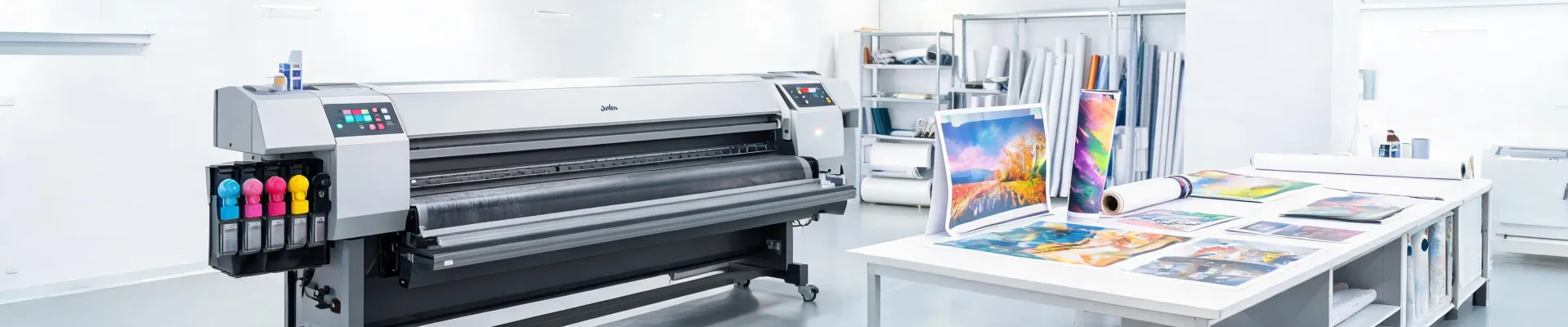
A Clearance Sublimation Printer Can Be the Most Expensive Investment a Shop Makes
2026-09-09 · Elise Marceau
Earlier this year, a production manager I used to work with called me about a clearance sublimation printer. The machine was from a reputable brand, the price was roughly 30% below the list price of the current model, and he kept saying the same phrase: "We'd be stupid not to buy it."
I asked him three questions. Which printhead does it use, and is that printhead still in production? What is the real ink cost per square foot on that model? And if the machine goes down, can anyone get parts within a week? He didn't have answers to any of them. That silence is exactly where the problem starts.
I've managed procurement for a mid-sized print production company for years, and I've tracked every invoice we've paid for printers, parts, and consumables. The pattern I see over and over is not that people buy bad printers. It's that they treat a printer as a one-time purchase when it's actually a recurring cost machine. A clearance sublimation printer looks smart on the purchase order. The real accounting shows up later, in printheads, ink, wasted operator time, and reprints.
The Machine's Price Is Often the Smallest Line on Its Cost Report
That sounds counterintuitive, so let me explain it the way I explain it to my own team: when you buy an industrial printer, you're not buying a product. You're signing up for a monthly flow of consumables, wear parts, maintenance, and downtime risk. The purchase price is just the entry ticket.
I remember auditing our 2023 spending and finding that the printers themselves accounted for less than a third of what we spent on printing technology that year. The rest went to printheads, ink, service calls, and replacement parts. That's normal for this industry. But most buying decisions are made as if the opposite were true, with all the attention on the discount at the bottom of the quote.
It doesn't help that our procurement instincts are shaped by consumer purchases. When we buy a laptop or a car, the sticker price is the dominant number. For production equipment, the sticker price is almost secondary. The dominant numbers are cost per print, uptime, and how long the machine stays productive.
Three Places Where "Cheap" Gets Expensive
After watching dozens of purchasing decisions, I've narrowed down where the math usually falls apart. It's rarely one big mistake. It's three smaller mistakes that compound.
Clearance Sublimation Printer: The Price Goes Down as Support Gets Thinner
First, let me be fair: clearance deals aren't automatically bad. Sometimes the seller needs floor space, or the model was overproduced. But when a printer is discontinued because a new model uses a different printhead platform, the old machine's parts situation changes quickly. The manufacturer doesn't keep producing parts forever. Resellers sell what's in the warehouse, and once that stock is gone, the supply of a critical printhead becomes expensive and slow.
The discount on a clearance sublimation printer might be $6,000. The printhead for that machine, if you can find one, might cost $1,200 plus shipping. If the head fails twice over the machine's life, you've lost a quarter of your savings before counting the downtime. And if you can't find the head at all, the "deal" becomes a very large paperweight. I'm not saying every clearance unit is a trap. I'm saying the total cost of a discontinued model should include the cost of its disappearing supply chain, and almost nobody puts that number in the spreadsheet.
DTF Printer Sizes Are a Capacity Decision, Not a Floor-Space Decision
The same logic applies when people choose a DTF printer based on size alone. DTF printer sizes sound simple: a 13-inch model, a 17-inch model, a 24-inch model. But the width you choose is not just about the machine footprint. It determines your film width, your throughput, and how many garments you can actually process in a day.
I've seen a shop buy a smaller DTF printer because it was $8,000 cheaper and fit neatly in an unused corner. Then they started running back prints and full-size designs, and the smaller width forced them to split designs or use more film. Production time went up, film waste went up, and the bottleneck moved from the printer to the finisher and shaker. The machine itself was fine. The size was wrong for the product mix.
Before you compare printers by price, compare them by the width of your actual jobs. If even 20% of your work needs a 24-inch transfer, a 13-inch machine will cost you more in labor than you saved on the purchase. The size spec isn't a dimension. It's a capacity limit.
UV Resistant Ink for Inkjet Printer: The Fine Print Matters More Than the Price
Ink is where the biggest hidden cost lives. For outdoor work, people ask about UV resistant ink for inkjet printer applications without asking what "UV resistant" actually means in a specific ink set. Some inks resist fading for years. Others resist it just long enough to pass a sales demo.
I remember quoting an exterior sign job where the customer expected three years of color stability. We used an economy ink set that looked fine in the first month. By month eight, the colors had shifted noticeably. The sign didn't peel or crack, it just faded unevenly. The customer didn't complain, they simply never ordered from us again. The reprint cost was bad enough. The lost repeat work was worse.
UV resistant ink for inkjet printer systems can vary in pigment load, binder chemistry, and compatibility with your specific printhead. A cheaper ink might save $0.04 per square foot and cost you a $1,200 reprint plus the damage to your reputation. When I see a deal that includes a heavily discounted printer and a heavily discounted ink bundle, I automatically assume the cost was moved somewhere else.
What I Now Compare: Dollars per Square Foot
After a few expensive lessons, I stopped asking which printer had the best price. I started asking which printer produced the lowest all-in cost per square foot over 36 months.
This is the calculation that changed everything: take the machine price, add the estimated printhead replacements over three years, add the realistic ink consumption for your monthly volume, add the service contract and expected downtime, then divide by the total square footage you expect to produce in that period. The answer tells you what the machine actually costs. The clearance discount is just one line in that calculation, and it's rarely the line that decides the result.
When we ran the numbers on a potential clearance sublimation printer in our own shop, the machine's discounted price would have saved us about $7,000 over the replacement model. But the older machine used more ink per square foot and its printhead was already harder to source. Over three years, the clearance unit would have cost us about $4,000 more than the newer model despite the lower purchase price. The discount wasn't a discount. It was a repackaged future expense.
What I'd Check Before Signing the Purchase Order
If you're looking at Mutoh printers or any other wide-format brand, the questions that matter are not about the demo print quality. They're about what happens after the demo.
First, ask for the printhead part number and check whether that printhead is used in other current machines. Shared printhead platforms mean better parts availability. Second, ask for the ink cost per square foot in writing, not just the price per bottle. Third, ask about the machine's realistic monthly duty cycle and compare it with your actual production needs. Finally, ask your service tech how long it would take to get a replacement printhead. If the answer is more than a week, the purchase price needs to drop by enough to cover a week of lost production.
I've also learned to look at the company's history. Mutoh started in an era when a Mutoh drafting machine was a serious piece of engineering equipment. Those drafting machines are long gone from the market, but they tell you something important: the company has been building precision equipment for a long time. That doesn't automatically mean every current model is the right fit for your budget, but it does mean the engineering culture wasn't created yesterday. I use that as a signal, not as the whole decision.
Honestly, I'm still not sure why some shops get away with buying the cheapest option and never paying for it later. My best guess is that they run low volumes, have flexible deadlines, and keep a backup printer somewhere. If that's your situation, a clearance sublimation printer might genuinely work for you. My experience is based on mid-sized production floors where downtime is measured in lost customer deadlines, not in idle hours. If you're running a smaller operation, the math shifts. But the principle doesn't: the lowest quote is only the beginning of the cost discussion, not the end of it.
There's something satisfying about finding a printer deal that actually produces cost savings. The best kind of saving, though, is the one that survives contact with printheads, ink, and a full year of production. That's the only discount worth planning for.

Elise Marceau
Elise Marceau is an LED display and digital-signage systems analyst covering LED video walls, modular screens, transparent LED, control processors, and indoor or outdoor signage. She applies IEC 62368-1 safety principles while comparing pixel pitch, luminance, contrast, refresh rate, colour uniformity, viewing angle, ingress protection, power density, module serviceability, and signal redundancy. Her specification guides help integrators, venue operators, retailers, and procurement teams align viewing distance, ambient light, content format, installation access, electrical load, and lifecycle support.