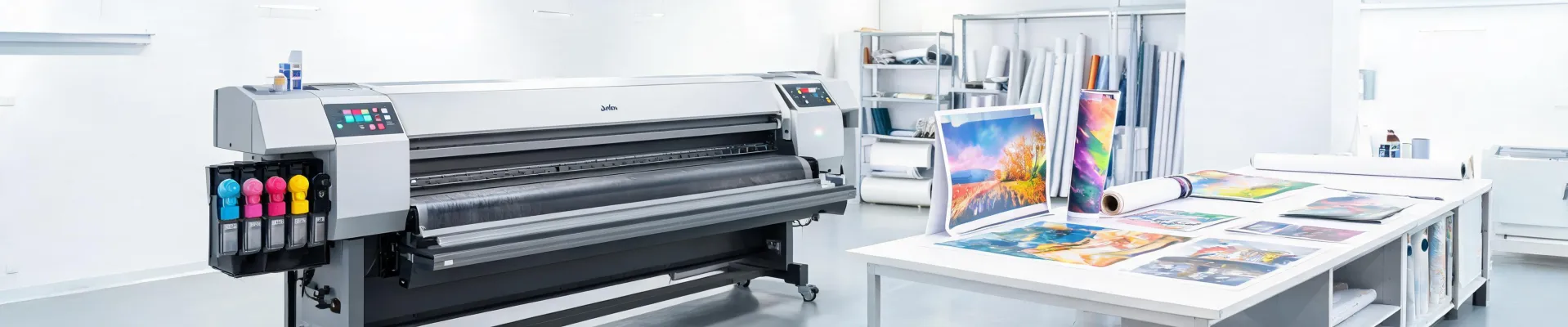
6-Step Checklist for Buying a Wide-Format Printer: Mutoh, DTF 101, Panda UV, and Refurbished Options
2026-08-31 · Elise Marceau
-
Step 1: Define Your Actual Workflow (Not the Spec Sheet)
-
Step 2: Calculate the Real Cost of That "Cheap" Printer
-
Step 3: Check the Refurbished Route Before Committing
-
Step 4: For DTF/DTG and UV, Narrow Down by Media Type
-
Step 5: Verify Support and Parts Availability
-
Step 6: Run a Hands-On Test Before Signing
-
Seven Mistakes I Made So You Can Avoid Them
Two years ago I almost bought a printer based on a spec sheet and a slick demo. That would have been a $31,000 mistake. I've been running a sign and apparel shop since 2017, and I've personally made and documented 11 significant purchasing mistakes that cost a total of nearly $68,000. This checklist is what I use now. It's for anyone evaluating a new or refurbished industrial printer — including Mutoh UV models, the DTF 101, a Panda UV flatbed, or a used thermal inkjet. Go through these six steps before you sign anything.
Step 1: Define Your Actual Workflow (Not the Spec Sheet)
The spec sheet shows print speed, resolution, and media width. It doesn't show how the machine behaves across a full week of mixed jobs. When I compared two candidate machines side by side with the same print speed and resolution, I finally understood why workflow trumps specs. On paper, they were twins. In practice, one ran 30% more jobs per day because its media handling was simpler.
Write this down before you look at any brochure:
- Top 3 media types you routinely print on (vinyl, corrugated plastic, canvas, garment transfers...)
- Typical order size: one-offs, runs of 50, or production runs of 100+
- How often you change ink types or media thicknesses per day
If you're considering a Mutoh printer cutter combo, add a specific question: how does the built-in cutter handle the exact media you use? I once ran a 12-oz banner through a printer-cutter and the contour cut misaligned by 3mm after 40 feet. It killed a $1,200 order. The dealer never mentioned the media thickness limit. I didn't check. That was on me.
Step 2: Calculate the Real Cost of That "Cheap" Printer
From the outside, a budget DTF 101 printer looks like a no-brainer. The reality is that consumables and spare parts can double the cost within the first year. People assume the lowest quote means better value. What they don't see are the hidden costs hiding in printheads, ink, and downtime.
Here's a simple formula I now run:
Purchase Price + (Printhead Cost × Replacement Rate) + (Ink Cost per Square Foot × Monthly Volume) + (Downtime Cost per Day × Probability of Failure) = Your Budget
As of March 2025, publicly listed prices for the Mutoh XpertJet 1641SR range from $34,000 to $42,000 depending on configuration, based on listings from three industrial equipment resellers. A refurbished thermal inkjet printer I evaluated was listed at $8,500. But the printhead replacement on that refurb was $2,400 and projected to fail within 18 months. The Mutoh's heads lasted more than twice as long and the first service was included.
Bottom line: over three years, the "cheap" refurb was only $6,000 less expensive — but it came with 14 days of downtime.
Step 3: Check the Refurbished Route Before Committing
I'm not against refurbished thermal inkjet printers. They work well for a low-volume side shop or as a backup. But here's an honest limitation: if your production runs 20 hours a day, a refurbished machine is a gamble.
I went back and forth between a refurbished thermal inkjet and a new UV flatbed for three days. The refurb was $12,000 cheaper. The new one had a two-year warranty. I chose the new one because a failed printhead on a big order would cost far more than the difference in price.
If refurbished still makes sense for you, ask for:
- Maintenance history and total printhead hours logged
- Whether it's manufacturer-refurbished or dealer-refurbished
- Warranty terms and whether calibration is included
- Onsite training or a hotline for the first month
That last one is the step most buyers skip. I skipped it once and paid a retired tech $1,800 to teach me how to set up a machine that came with a 2009 PDF manual. Not ideal.
Step 4: For DTF/DTG and UV, Narrow Down by Media Type
The "one machine does everything" advice ignores chemistry. DTF printers like the DTF 101 are excellent for garment transfers, but they struggle with fine details on hard substrates. UV printers like the Panda UV flatbed are great on acrylic and aluminum composite, but the ink flexibility is limited on vinyl wraps.
The Panda UV printer looks tempting because of its price — often under $20,000. But it's not a replacement for an eco-solvent or a latex printer. If your shop does vehicle graphics, the Panda UV ink will crack when the vinyl stretches. People assume a UV flatbed is more versatile because it prints on more materials. In practice, material compatibility without the ability to stretch or bend is a serious constraint.
The numbers said the Panda UV printer was the best value: fast, same resolution, half the price of a Mutoh. My gut said the white ink on the test sample was brittle. I listened to my gut and chose a different machine. Six months later, a friend's Panda UV had exactly that issue on a full-side delivery truck rewrap. That was a $4,500 redo.
Step 5: Verify Support and Parts Availability
The Mutoh XpertJet 1641SR's list price is competitive for its class. But you're not buying a printer; you're buying a support system. I've seen a $35,000 Mutoh sit idle for 16 days because the local dealer didn't stock a $44 damper. That delay cost the shop $9,600 in missed deadlines. The printer itself was fine. The shortage of parts was the real risk.
Ask these questions before you commit:
- How many spare printheads does the dealer keep in stock for the model you want?
- What's the average response time for a repair ticket?
- Is there a local technician within 100 miles?
- Does the warranty cover parts, labor, or both?
If the vendor says "we provide support via email ticket only," that's a red flag. Period.
Step 6: Run a Hands-On Test Before Signing
Never trust a vendor's demo file. I had a demo that looked gorgeous, but when I ran a dual-density banner file, the ink laydown patterns showed banding. The vendor said it was "within tolerance." Not for my client.
Bring your own files and your own media. Do this:
- Print a 3-foot continuous image on your typical banner material — not the premium stock the vendor supplies.
- If the machine has a white ink channel, test it on a transparent film or colored substrate.
- Run the same file twice in one session to check color consistency.
- Do a scratch test and a bend test after 24 hours.
- If you're buying a refurbished thermal inkjet, ask for a live nozzle check and print a 12-step gray ramp to detect head wear.
That's it. If the seller won't let you run those tests, walk. Simple.
Seven Mistakes I Made So You Can Avoid Them
- Buying for one big job. A single $8,000 contract convinced me to buy a machine that was terrible for my daily mix of small orders. It sat idle for months.
- Ignoring environmental requirements. The DTF 101 printer I looked at needed a 20-amp circuit and a dehumidifier. I hadn't budgeted for electrical work.
- Assuming printhead prices won't change. I got quoted $2,400 for a printhead, then six months later it was $3,100. Once you own the machine, prices move upward.
- Not checking the cutter's real capability. A "printer cutter" on a Mutoh — or any wide-format — is often a contour plotter, not a heavy-duty media cutter. For thick magnetic sheeting, you'll still need a separate cutter.
- Going with the cheapest third-party ink. I saved 30% on ink and the color gamut shifted. Thirty-seven orders came out wrong. Now I run OEM inks for client work.
- Ignoring training costs. A refurbished thermal inkjet printer with no setup support will cost you more in trial-and-error than you saved. You can't learn production-printing math from a grainy PDF.
- Trusting word-of-mouth about a niche printer brand. "The Panda UV printer works great" usually means it worked great for someone else's specific workflow. That doesn't mean it will work on yours.
This checklist won't tell you which machine is perfect — no one can do that for you. It will tell you which questions to ask, what to test, and where the real costs hide. That's what saved me from a $31,000 mistake. Use it, and the chance of a nasty surprise goes down way more than you'd expect. That's the goal.

Elise Marceau
Elise Marceau is an LED display and digital-signage systems analyst covering LED video walls, modular screens, transparent LED, control processors, and indoor or outdoor signage. She applies IEC 62368-1 safety principles while comparing pixel pitch, luminance, contrast, refresh rate, colour uniformity, viewing angle, ingress protection, power density, module serviceability, and signal redundancy. Her specification guides help integrators, venue operators, retailers, and procurement teams align viewing distance, ambient light, content format, installation access, electrical load, and lifecycle support.